THE FALLACY BELIEF OF THE BIRTH CERTIFICATE AS A SECURITY OR SECRET TREASURY ACCOUNT
18th June 2026
The contemporary global financial architecture functions as a highly integrated, multi-layered administrative trust managed by the United States Department of the Treasury, which acts in the capacity of a bankruptcy trustee within a perpetual state of national reorganization. This structural arrangement, which governs domestic and international commercial interactions, is frequently conceptualized by jurisdictional researchers as an artificial "Monopoly board" of commerce. Under this regime, all legal and monetary interactions are essentially artificial, debt-based entries on a centralized ledger. Promoters of specialized private recoupment protocols, such as the "Clifford Protocol," have synthesized elements of negotiable instruments law, trust structures, and central banking mechanics to construct a parallel narrative of commercial redemption.
This report provides an exhaustive, expert-level deconstruction of the birth certificate construct, the usufruct relationship in a bankrupt system, the statutory application of the UK Bills of Exchange Act 1882, and the mechanical limits of signature credit tax redirection, contrasting these theories with hard judicial and administrative realities.
The Jurisdictional Transition of 1933 and the Usufructuary Monopoly Board
The foundation of modern debt monetization is historically linked to the formal insolvency of the United States federal corporation in 1933, a systemic crisis consolidated under the Emergency Banking Act of March 9, 1933. Following this transition, the passage of House Joint Resolution 192 (HJR 192) on June 5, 1933, fundamentally altered commercial obligations by suspending the right of creditors to demand payment in gold. Prior to this pivot, the monetary standard was characterized by the exchange of tangible assets for the discharge of debt under common law. Under the new regime established by HJR 192, the requirement for domestic obligations to be payable in substantive assets was suspended, effectively transforming the United States dollar from a warehouse receipt for precious metal into a "money of account"—a debt-based unit used to track commercial obligations within a closed-loop system.
Because the requirement to pay in substance was suspended, all public and private obligations are subsequently discharged using fiat credit. Federal Reserve Notes are defined not as money of substance, but as debt obligations of the U.S. Treasury that circulate as legal tender to balance ledger entries on the Monopoly board. By absorbing the physical assets of the private sector, the administrative state established a usufruct relationship. In this framework, the government borrows the productive capacity and credit energy of the living populace to serve as the primary source of value and ultimate collateral for national debt obligations.
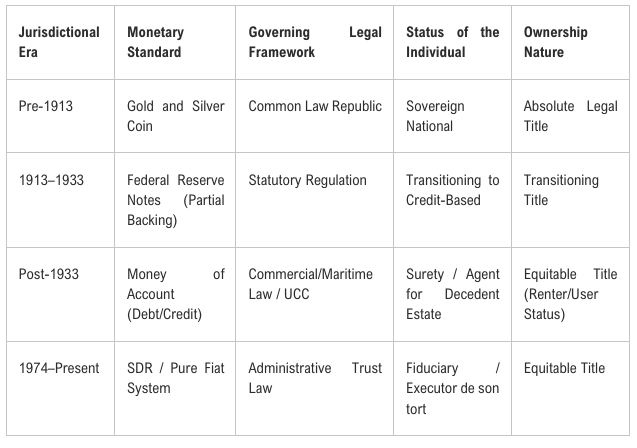
This usufruct relationship is operationalized at birth through the registration of birth certificates. This registration process effectively mortgages the collective future labor of the populace to the creditors of the bankrupt state. Upon registration, the state utilizes the public record to create a "decedent estate" or a "corporate debtor construct" on government records. This artificial persona, typically identified by a Social Security Number (SSN) or Individual Taxpayer Identification Number (ITIN) in the United States, or a National Insurance Number in the United Kingdom, operates as a registered security on the government's books. Consequently, the living individual is presumed by default to operate merely as an agent and liable surety for this bankrupt corporate debtor, holding only equitable title to assets while the state retains legal title as bankruptcy trustee. Under this framework, the living individual is merely the operator of the decedent estate, which possesses the beneficial interest but lacks the authority to transfer the legal title held by the state. When an individual engages in commerce using the "ALL CAPS" name found on the birth certificate, they are presumed to be operating without formal authorization, assuming the role of an executor de son tort— an executor of their own wrong—who is held to strict fiduciary standards and personal liability for the debts of the estate.
The Ontological Status of the Birth Certificate and the Myth of the Secret Trust
A critical point of divergence between legitimate commercial law and pseudolegal "redemption" theory is the belief that the birth certificate itself can be "cashed in" or that it represents a secret trust with direct cash value. Adherents of the redemption movement frequently allege that a secret U.S. Treasury account or Cestui Que Vie Trust is established for every citizen at birth, funded with amounts ranging from $600,000 to $20 million. They argue that by filing a UCC-1 financing statement or presenting the birth certificate as a bond, they can tap into this "Exemption Account" to pay off private debts and taxes.
This narrative represents a fundamental misunderstanding of commercial paper and property law. The birth certificate is an administrative record of birth, not a negotiable instrument, a bond, or a security belonging to the living soul. It contains no monetary value, and "Exemption Accounts" are entirely fictitious terms that do not exist within the Treasury system. Because the state retains legal title over the birth certificate construct as a bankruptcy trustee, any attempt by an individual to "cash in" the certificate or draw sight drafts on a presumed Treasury Direct Account (TDA) constitutes a federal crime. Federal courts in both the United States and the United Kingdom have aggressively prosecuted promoters and participants of these schemes for wire fraud, counterfeiting, passing fictitious financial instruments, and filing false tax returns. The true utility of the birth certificate construct does not reside in its direct cash value, but in what it enables the living soul to do as a recognized legal participant on the Monopoly board. It establishes the legal persona through which the living soul, acting in a fiduciary capacity, can add new negotiable instruments (such as promissory notes, cheques, or bills of exchange) to the commercial ledger. The living soul operates the decedent estate as a private banking house, issuing and managing its own signature-originated assets. Reclaiming control over this process requires shifting one's capacity from a subordinate, silent "retail debtor" to a "fiduciary creditor," using recognized commercial and tax codes rather than attempting to liquidate a non-existent state-funded trust.