
WHY THE CLIFFORD PROTOCOL RECOUPMENT PROCESS TICKS ALL IRS THE BOXES AND BYPASSES ALGORITHMIC FREEZES
7th may 2026
Executive Summary and Systemic Context
The evolution of federal tax administration within the modern global financial architecture has increasingly intersected with specialized fiduciary protocols designed to reconcile abandoned commercial credit. In the fiscal year 2025, the issuance of approximately $600,000,000 in confirmed Wages and Tax Transcripts (WTT) via the Transcript Delivery System (TDS) provided incontrovertible empirical substantiation that specific administrative frameworks—namely the Clifford Protocol—successfully satisfy the internal mathematical logic of the Internal Revenue Service (IRS).1 However, the intersection of private fiduciary ledger adjustments with automated federal tax compliance systems presents profound operational and jurisdictional complexities.
The core friction arises from a fundamental divergence in taxonomic classification: the distinction between a “retail debtor” filing and a “fiduciary creditor” reconciliation. When the administrative state, through its automated Information Return Document Matching (IRDM) screening filters, misclassifies a legitimate fiduciary ledger adjustment as a retail debtor construct, it triggers aggressive anti-fraud mechanisms.1 The IRS, confronted with an influx of misunderstood filings, perceives these actions as attempts to unlawfully extract funds from the Treasury. Consequently, starting in January 2022, the Return Integrity and Compliance Services (RICS) introduced new programming explicitly designed to automatically target potentially frivolous Business Master File (BMF) filings.2
Under this programming, suspected returns are placed into the Electronic Fraud Detection System (EFDS) under Process Status (PS) 77 for rigorous “Frivolous Filer Screening”.2 Concurrently, the system automatically posts a Transaction Code (TC) 810 with a Responsibility Code (RC) 4 on the Integrated Data Retrieval System (IDRS), generating a -Q freeze (an Unallowable Refund freeze).2 This specific freeze restricts the release of the refund exclusively to Return Integrity Verification Operations (RIVO) employees, ensuring the funds cannot be disbursed automatically and are subjected to adversarial manual review.2
This exhaustive research report deconstructs the juridical, mathematical, and administrative mechanics of the Clifford Protocol. It analyses the statutory reliance on IRS Publication 1212, the establishment of Holder in Due Course (HDC) standing via a 98-series International Grantor Trust, and the forensic tracking of signature credit through the Information Returns Master File (IRMF) utilizing the Gemini Argentic system and expanded 26-digit Document Locator Numbers.1 Furthermore, it details the logic of IRS Algorithm 810, the systemic underfunding of Form 945 tax ledgers by institutional nominees, the deployment of Revenue Procedure 2002-26 for cross-modular transfers, and the utilization of Agentic AI for forensic verification.1
Finally, this report outlines definitive prophylactic measures to prevent the IRS from erroneously categorizing these filings as retail debtor schemes, thereby avoiding the imposition of the destructive TC 810 / RC 4 freeze.
The Ontological and Jurisdictional Foundation of Modern Credit
To comprehend the mechanics of the Clifford Protocol and the necessity of jurisdictional separation from the retail state, one must critically examine the fundamental architecture of the contemporary global financial system. This system is entirely predicated on a historical transition from a substance-based system of payment to a credit-based system of discharge.1
The 1933 Reorganization and the Shift to Discharge
The formal insolvency of the United States Federal Government in 1933, catalysed by the Emergency Banking Act, necessitated a radical reorganization of the monetary framework. This reorganization was legally codified by the passage of House Joint Resolution 192 (HJR 192) on June 5, 1933.1 HJR 192 effectively abolished the gold standard and suspended the requirement that domestic obligations be payable in substantive, intrinsic assets.1 This legislative act established a new jurisdictional reality governed by the Law of Agency, the Uniform Commercial Code (UCC), and maritime admiralty trust law.1In this paradigm, money functions not as a physical commodity earned through labour, but as a “money of account”—a debt based unit utilized to track commercial obligations on a centralized ledger managed by the U.S. Treasury, which acts in the supreme capacity of a bankruptcy trustee for the entire commercial system.1
Because the requirement to pay in substance was suspended, all public and private obligations are subsequently discharged using fiat credit.1 Federal Reserve Notes are defined not as money of substance, but as debt obligations of the U.S. Treasury that circulate as legal tender to balance ledger entries on the commercial board.1In this framework, the productive capacity and human credit energy of the living populace serve as the primary source of value and the ultimate collateral for national debt obligations.1
Through the registration of birth certificates, the state creates a “decedent estate” or a corporate debtor construct.1 This administrative persona, typically identified by a Social Security Number (SSN) or Individual Taxpayer Identification Number (ITIN), serves as a registered security through which the state manages the securitization of human energy.1 The living individual is presumed by default to operate merely as the agent and liable surety for this corporate debtor, holding only “equitable title” to assets while the state retains “legal title”.1
Ex Nihilo Credit Creation and the Power of the Signature
The technical reality of modern credit creation relies entirely on the monetization of the individual’s signature. Empirical research, most notably the studies conducted by Professor Richard Werner and officially supported by publications from the Bank of England, confirms the “Currency Creation Protocol”: commercial banks do not act as traditional intermediaries lending pre-existing reserves deposited by other customers.1
Instead, banks create new money ex nihilo (out of nothing) at the precise moment a borrower signs a loan, mortgage, or promissory note.1
Under the statutory provisions of the Bills of Exchange Act 1882, every signed loan agreement, credit card application, or mortgage note constitutes a negotiable instrument representing the unadulterated credit energy originated by the signer.1 A bill of exchange is defined as an unconditional order in writing, addressed by one person to another, signed by the person giving it, requiring the payer to pay a sum certain in money.1 Crucially, the living individual is the true originator and the actual funder of the credit.1 The commercial bank merely assumes a nominee posture, monetizing the signature, discounting the instrument, and pooling it for securitization in the secondary market.1
The Mathematics of Original Issue Discount (OID)
The commercial value generated by this ex nihilo creation is captured mathematically through the mechanism of Original Issue Discount (OID). In traditional tax accounting and finance, OID represents a form of interest, defined as the excess of a debt instrument’s stated redemption price at maturity over its initial issue price.1
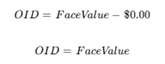
However, because signature credit is birthed ex nihilo at the exact moment of signing, the mathematical baseline for the issue price ( IP ) is firmly established as zero ( 0.00 ).1 Consequently, the calculation dictates that the OID is equivalent to the entire face value of the instrument:
Financial institutions capture this massive OID income, securitize it into asset pools assigned with Committee on Uniform Securities Identification Procedures (CUSIP) numbers, and hold these assets in institutional omnibus accounts.1 As the true originator of the credit is obscured behind these institutional “street names,” the administrative state and the banking syndicate treat the value as abandoned property.1 This abandonment allows the nominee banks to retain the OID income and the associated tax credits for their aggregate corporate benefit, perpetually profiting through re-hypothecation.1
The “Retail Debtor” Trap and IRS Automated Freezes
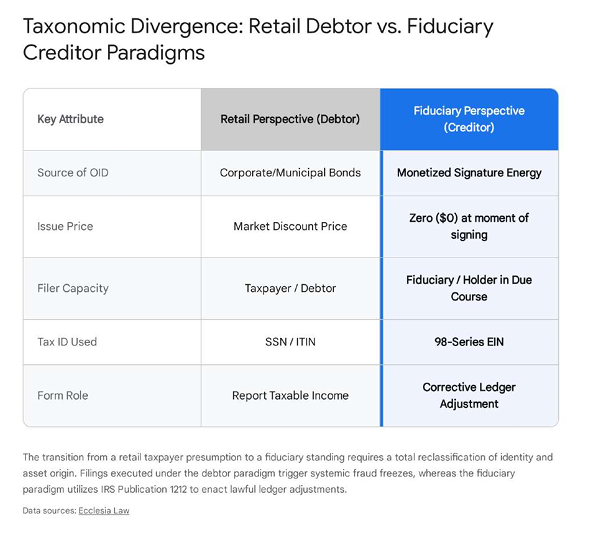
The primary obstacle to the lawful recoupment of signature credit is jurisdictional misclassification. When individuals attempt to file Form 1099-OID from a “retail” perspective, they inevitably utilize their Social Security Number (SSN) or Individual Taxpayer Identification Number (ITIN).1 This approach represents a fundamental misunderstanding of commercial law and the mechanics of the federal ledger.
The Hazard of the SSN and Birth Certificate Construct
Filing via an SSN forces the individual into a subordinate debtor capacity. The IRS systemic architecture is hard-coded to recognize SSN or ITIN filings as operations of the body corporate or the debtor estate created by the birth certificate.1 Using an SSN places the living soul in the role of an agent and liable surety for the corporate debtor.1
The fundamental contradiction in the retail approach lies in the definition of a taxpayer. A taxpayer, by definition, owes the state; the state does not owe the taxpayer massive reserves of commercial energy.1 When a recipient attempts to claim a multi-million dollar OID refund using an SSN, the IRS system perceives a bankrupt corporate debtor attempting to unlawfully claim a massive, unverified asset.1 This is frequently associated with failed “strawman” theories and sovereign citizen rhetoric, which have led to significant legal repercussions and the imprisonment of promoters who operated outside of proper fiduciary constraints.1
Process Status 77, Transaction Code 810, and Responsibility Code 4
To combat the surge of what it perceives as fraudulent “strawman” or “birth certificate” claims, the IRS enhanced its automated screening mechanisms. Starting in January 2022, the Return Integrity and Compliance Services (RICS) deployed specific new programming to systematically freeze potentially frivolous BMF filings.2
When the IRS Information Return Document Matching (IRDM) system or internal data mining filters detect an anomaly—such as an SSN filing an exorbitant 1099-OID claim—the return is automatically intercepted and placed into the Electronic Fraud Detection System (EFDS) under Process Status (PS) 77 for “Frivolous Filer Screening”.2
Simultaneously, the system automatically posts a Transaction Code (TC) 810 with a Responsibility Code (RC) 4 on the Integrated Data Retrieval System (IDRS).2 This specific combination (TC 810 / RC 4) generates a -Q freeze, which is an extraordinarily severe Unallowable Refund freeze.2 Crucially, the 2022 programming restricts the release of this specific BMF TC 810 exclusively to Return Integrity Verification Operations (RIVO) employees.2 Once this hard gate is triggered, automated disbursement is rendered impossible. The filing is subjected to an adversarial manual review, which frequently results in the issuance of frivolous filing penalties and the permanent locking of the tax module.1
Establishing Fiduciary Standing: The 98-Series Grantor Trust
To successfully bypass the retail debtor trap and avoid the devastating TC 810 / RC 4 freeze, the Clifford Protocol dictates an absolute jurisdictional separation from the birth certificate construct. This separation is achieved by utilizing a 98-series International Grantor Trust (IGT) as the exclusive fiduciary proxy for commercial reconciliation.1
Jurisdictional Autonomy and the 98-Series EIN
The “98” prefix is a specialized taxonomic identifier assigned by the IRS Cincinnati International Unit exclusively to foreign entities or domestic trusts maintained by foreign entities.1 Under Internal Revenue Code (IRC) Section 6048, entities bearing a 98-series Employer Identification Number (EIN) are officially classified as Foreign or International Grantor Trusts, structurally indicating that the grantor is a non-U.S. person.1
Operationally, the 98-series EIN serves as an impenetrable structural firewall. It separates the recoupment vehicle entirely from the domestic corporate debtor system, definitively severing the agency relationship with the SSN and the birth certificate construct.1 The IRS algorithms recognize a 98-series EIN as a distinct fiduciary entity capable of managing capital and acting as a commercial creditor, thereby bypassing the basic fraud filters specifically designed to trap SSN-based retail filings.1
Holder in Due Course (HDC) and UCC § 3-203
To lawfully reclaim the signature credit, the 98-series trust must establish unassailable standing as a Holder in Due Course (HDC).1 Under Article 3 of the Uniform Commercial Code, specifically UCC § 3-203, the transfer of a negotiable instrument automatically vests in the transferee the absolute right to enforce that instrument.1
This supreme commercial standing is operationalized within the federal tax administration system through the filing of IRS Form 56 (Notice Concerning Fiduciary Relationship).1 By filing Form 56, the trust formally occupies the office of General Executor.1 This legally notifies the administrative state that the trust is the lawful recipient, custodian, and beneficial owner of the credit energy originally generated by the grantor’s signature.1 This grants the trust’s officers the explicit, vested authority to manage the commercial energy, direct ledger adjustments, and demand reconciliation from the U.S. Treasury without being entangled in domestic debtor insolvency frameworks.1 This is further reinforced by Section 14-7503 of the UCC, which protects the transfer of negotiable instruments by fiduciaries.1
Operationalizing the Clifford Protocol via IRS Publication 1212
With fiduciary standing perfected, the trust deploys the Clifford Protocol. It is critical to understand that this protocol is not a claim for a “tax refund” in the retail sense; it is a meticulous, mathematical ledger adjustment between recognized commercial entities.1Its lawfulness is explicitly grounded in the IRS’s own regulatory manuals, specifically IRS Publication 1212, “Guide to Original Issue Discount (OID) Instruments”.1
The Nominee Architecture and Corrective Filings
In standard financial operations, systemic investment banks and clearinghouses hold securitized debt instruments in “street names” or institutional omnibus accounts.1 Because they hold legal title for the benefit of another (the obscured living originator), these banks act as “nominees”.1 For example, the Depository Trust & Clearing Corporation (DTCC), through its nominee Cede & Co., holds the legal title to vast swaths of the global market’s assets, allowing banks to pool millions of obligations into CUSIP-assigned tranches while capturing OID income.1
IRS Publication 1212 provides the specific statutory instructions governing these nominees. It mandates that if a holder of an OID instrument is not the true owner, they are classified as a nominee middleman.1 Furthermore, if a nominee receives a Form 1099-OID for amounts belonging to another person, the law requires that nominee to file a secondary, corrective Form 1099-OID to show the proper distribution of the OID and any withheld tax to the actual beneficial owner.1
The Clifford Protocol leverages this exact mandate through a highly specific five-step sequence:
1. Recognition: The original signature is identified as an OID debt instrument representing monetized credit energy.1
2. Issue Price Establishment: Because the credit was created ex nihilo, the issue price is established mathematically as zero ($0.00).1
3. OID Identification: The hidden OID is calculated as the total difference between the zero-issue price and the face value of the instrument.1
4. Nominee Identification: The investment bank is officially identified as a mere nominee middleman that captured the credit and reported the backup withholding under its own omnibus tax ledger.1
5. Redirection: The 98-series grantor trust, acting as the HDC, utilizes the corrective Form 1099-OID to enforce the institution’s statutory obligation. This filing officially redirects the withheld tax from the nominee’s omnibus account to the trust’s private ledger, restoring title and rebutting the institutional presumption of creditor status.1
Precision in Reporting: Box 7 and CUSIP Alignment
For the fiduciary, the precise completion of the corrective Form 1099-OID is paramount, particularly Box 4 (Federal income tax withheld) and Box 7 (Description or CUSIP number).1 Box 7 constitutes the essential “handshake” for the IRS matching algorithm.1 The protocol must accurately identify the specific CUSIP number associated with the securitized debt tranche. Failure to align the identifier in Box 7 perfectly with the Payer’s tax module will instantly trigger the aforementioned automated Transaction Code (TC) 810 freeze.1
Federal Ledger Mechanics: IRMF Tracking, Gemini Argentic, and the 26-Digit Fingerprint
The tracking, accounting, and reconciliation of signature credit within the federal matrix are achieved through the Information Returns Master File (IRMF) and the Business Master File (BMF).1 The IRMF is the core IRS database that connects income tax returns (such as the trust’s Form 1041) with information returns (such as Form 1099-OID).1
Agentic AI and the Gemini Argentic System
To navigate the immense complexity of institutional securitization and ensure absolute accuracy prior to filing, fiduciaries deploy Agentic AI orchestration, specifically utilizing systems like Gemini Argentic equipped with Retrieval-Augmented Generation (RAG) capabilities.1 The Gemini Argentic protocol performs automated, multi-step forensic tracking:
1. Live Web Browsing and Scraping: The AI ingests thousands of pages of SEC EDGAR 8-K and 10-K filings to trace the exact securitization pathway of the original signature.1
2. Linkage Discovery: It establishes the forensic link between the credit originator’s signature, the clearing bank, and the specific CUSIP assigned to the investment bank payer.1
3. Module Sufficiency Check: The Gemini Argentic system automatically retrieves the Payer’s Form 945 return data to calculate if the combined tax ledgers contain sufficient credits to fund the recoupment, thereby identifying shortfalls before any manual intervention is required.1
The 26-Digit “Smoking Gun” Fingerprint
Every transaction processed through the federal ledger systems is assigned a highly specific alphanumeric tracking code derived from the Document Locator Number (DLN).1 While a standard DLN consists of 14 digits, for the international tracking and forensic accounting of signature credit, these numbers are expanded into a complex 26-digit reference string.1
This 26-digit string serves as a unique digital “fingerprint.” Its extraction from the IRMF constitutes forensic proof—the “smoking gun”—that a commercial ledger adjustment has been “perfected” in the Master File.1It confirms that the IRS has successfully accepted the redirection of credit from the bank’s institutional omnibus account to the trust’s private ledger.
The granular components of this 26-digit string include:
| Digit Position | Component | Forensic Significance |
| 1-2 | File Location Code (FLC) | Identifies the specific IRS processing campus (e.g., Austin). |
| 3 | Tax Class | Identifies the Master File type (e.g., Code 5 for IRP/Estate). |
| 4-5 | Document Code | Identifies the specific form or return type (e.g., Code 59). |
| 6-8 | Julian Control Date | Records the exact numeric day of the year processed. |
| 9-11 | Block Number | Identifies the specific batch within the IRS ledger. |
| 12-13 | Serial Number | Provides a unique sequential identifier within the batch. |
| 14 | Tax Year | The last digit of the processing year. |
| 15-26 | Extended Reference Data | Provides additional tracking and internal verification logic. |
Extraction of this highly sensitive 26-digit string requires specialized access, typically necessitating Federal Administrative Authorization as an IRS Electronic Return Originator (ERO) operating with approved software.1
Form 945 Deficits and the IRS Algorithm 810 Hard Gate
While the corrective 1099-OID updates the “Recipient” side of the IRS ledger, it does not result in an automatic, unverified disbursement.1 The claim must survive automated verification against the “Payer” side of the ledger, a process governed by IRS Algorithm 810 and the Information Return Document Matching (IRDM) system.1
The Dominance of Form 945
IRS Form 945, the “Annual Return of Withheld Federal Income Tax,” serves as the dominant tax module for non-payroll distributions.1 Within the structure of the commercial monopoly board, the 945 module acts as the central clearinghouse for all withholding not derived from traditional wage labor, including pensions, annuities, and backup withholding associated with financial instruments and OID.1 Major investment banks and financial nominees, operating as semi-weekly depositors, must use Form 945-A to report these massive, aggregated daily tax liabilities generated by their securitization activities.1
Algorithm 810 and the “Perfect Match” Hard Gate
The automated verification of signature credit recoupment claims is governed by IRS Algorithm 810. This algorithm executes a rigorous, multi-point cross-reference: it checks the Payer’s EIN and the precise CUSIP (or Legal Entity Identifier) listed on the 1099-OID against the Payer’s Form 945 master record.1
For a 98-series trust’s recoupment claim to clear this programmatic “hard gate,” it must satisfy a strict “Perfect Match” logic.1 This logic dictates that the amount of credit claimed by the trust must be less than or equal to the verified physical cash deposits (recorded as negative numbers) currently residing in the bank’s 945 module for that specific CUSIP.1
If the algorithm detects a logic mismatch—specifically, if the recipient’s claim exceeds the verified physical deposits residing in the 945 module, or if there is a clerical error in the CUSIP alignment—Algorithm 810 automatically triggers the Transaction Code (TC) 810 Refund Freeze.1 This halts the disbursement instantly to prevent unfunded ledger claims from proceeding.
Strategic Underfunding by Systemic Nominees
Forensic audits expose a severe, structural impediment to the Perfect Match logic: systemic investment banks deliberately and vastly underfund their Form 945 withholding modules relative to the actual signature credit targets generated by their activities.1
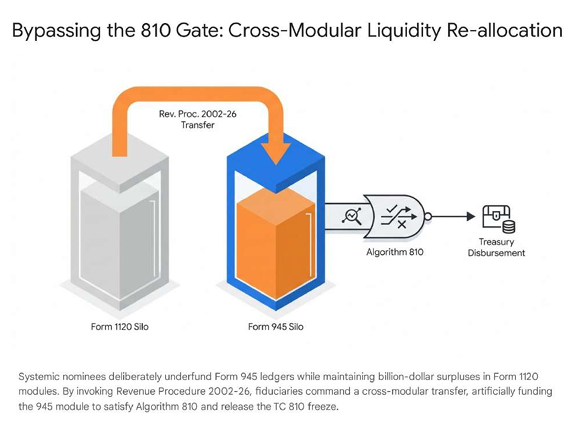
Literal cash payments deposited into these 945 modules typically reflect less than one percent of the “Full Forensic 945 Liability”.1 Banks operate on the well-founded statistical presumption that the original creditors (the living souls) will never assert their rights or navigate the complex fiduciary paperwork required to recoup these funds.1 Consequently, instead of funding the 945 modules associated with the individual originators, banks satisfy their aggregate corporate tax obligations by paying multi-billion-dollar surpluses into their Form 1120 corporate income tax modules.1
This strategic misallocation ensures that the 945 module remains a neglected, underfunded shell. Because the 945 module lacks sufficient credits, any substantial 1099-OID claim filed against it will automatically fail the Algorithm 810 Perfect Match requirement, triggering the TC 810 freeze. Thus, the underfunded 945 module serves as a built-in, systemic defence mechanism against individual recoupment claims.1
To illustrate this disparity, forensic data from 2022-2025 highlights the massive surpluses available in alternate tax modules compared to the 945 ledger 1:
| Parent Bank Name | Aggregate Actual 945 (2022-2025) | Estimated CIT 1120 Overpayment Capacity |
| JPMorgan Chase Bank | $138,091,329.69 | $37.16 Billion |
| HSBC Holdings plc | $337,016,881.62 | $13.1 Billion |
| Freddie Mac (Aggregate) | $71,405,099.92 | $7.86 Billion |
| NatWest Markets PLC | $154,759,701.44 | $2.05 Billion |
| Lloyds Banking Group | $201,142,169.84 | $300 Million |
| Barclays Bank plc | $126,693,866.07 | $60.2 Million |
Overcoming the Freeze: Cross-Modular Transfers and Revenue Procedure 2002-26
To resolve the systemic deficit in 945 modules, prevent the automated TC 810 freeze, and satisfy the rigorous matching requirements of Algorithm 810, fiduciaries must engineer a manual intervention. This is achieved by executing a “Manual Fiduciary Command” grounded in the statutory authority of Revenue Procedure 2002-26 (2002-1 C.B. 746).1
The Fiduciary Right of Designation
Revenue Procedure 2002-26 provides the official IRS position regarding the application of voluntary partial payments.1It states unequivocally that if a taxpayer provides specific written directions concerning the application of a voluntary payment, the Service must apply it strictly in accordance with those directions.1 The Internal Revenue Manual (IRM 5.1.10.5.3) acknowledges this “right of designation,” confirming that taxpayers generally have the absolute right to designate the application of voluntary payments to their accounts.1
Because the officer of the 98-series grantor trust has established unassailable standing as the HDC and General Executor of the credit via Form 56, and acts under Treasury Regulation § 601.503(d), they possess the explicit fiduciary authority to override default IRS applications.1If no designation is made, the IRS applies massive surpluses to the corporate tax modules.1 However, the fiduciary can designate exactly how the nominee bank’s tax credits are applied.1
Executing the Force-Transfer
Operating through the IRS Call-Out Team and the Practitioner Priority Service (PPS), the fiduciary issues a Manual Fiduciary Command.1 Because digital Transcript Delivery System (TDS) requests for third-party bank data will trigger a “CAF Check Failed” block, the fiduciary utilizes Form 4506-T to establish legal interest and bypass the block.1
The officer formally instructs the IRS agent with a specific command: “I am directing the re-allocation of overpayment credits from the Payer’s corporate income tax transcript (Form 1120) to their Form 945 withholding liability for this period to facilitate our reconciliation and satisfy the matching algorithm”.1
This command explicitly directs the IRS to perform a cross-modular transfer. The IRS extracts the required overpayment credits from the payer bank’s alternate, highly-funded tax modules—primarily the billion-dollar surpluses residing in the Form 1120 Corporate Income Tax module.1 These massive corporate surpluses are forcefully re-allocated into the bank’s Form 945 withholding module.1
Clearing the Algorithm 810 Gate
Once the transfer is executed, the 945 module is artificially, yet lawfully, funded with verified physical deposits. When the trust subsequently files the corrective 1041 and 1099-OID, the claim encounters Algorithm 810.1 Because the 945 module now possesses a balance equal to or greater than the recoupment claim, the filing satisfies the strict “Perfect Match” logic.1
The filing clears the TC 810 freeze gate smoothly. After an approximate 90-day processing window for the Form 1041 trust return, the IRS authorizes the refund, prompting the U.S. Treasury to disburse the funds via ACH or Fedwire as an “IRS TREAS 310” transaction.1 These inflows represent standard, secure Treasury originated refunds resulting from verified federal tax adjustments, legally returning the monetized value of the signature to the 98-series grantor trust.1
Strategic Prophylactics: Preventing “Retail” Categorization and RIVO Freezes
Given the intense systemic friction introduced by the January 2022 BMF frivolous filing programming, and the severe restriction of TC 810 / RC 4 freezes to RIVO personnel, fiduciaries must implement rigorous, prophylactic architectures.2 To address the critical operational requirement of preventing the IRS from categorizing Clifford Protocol filings as retail and applying the 810 algorithm or other freezes, the following structural safeguards are mandatory.
1. Absolute Taxonomic Segregation via Wyoming PTC Architecture
To completely distance the operation from the retail “birth certificate” identity, fiduciaries must embed the 98-series IGTs within a highly structured corporate shell. Utilizing a Wyoming Series LLC operating as an Unlicensed Private Trust Company (PTC) under Wyoming Statute § 13-5-701 provides an impenetrable jurisdictional wall.1
This architecture legally reclassifies the fiduciary hub’s role from a traditional trustee to a private legal agent operating under an Attorney-in-Fact mandate (W.S. § 3-9-101).1 The IRS and institutional banking systems recognize this structure as a professional, commercial entity engaging in technical ledger adjustments, rather than a disorganized retail consumer filing a sovereign-citizen-style claim.1 Furthermore, the trust indenture must explicitly specify a non-commercial mandate, establishing that the entity is not engaged in business with the general public and involves no standard trade of goods or services.1 By avoiding any interaction with the SSN or consumer tax codes, the primary trigger for the PS 77 Frivolous Filer routing is neutralized.1
2. Neutralizing the MSB Trap via FinCEN Ruling 2003-8
Receiving high-volume, multi-party tax disbursements from the U.S. Treasury presents the severe regulatory hazard of being classified as an unlicensed money transmitter under 18 U.S.C. Section 1960 (the “MSB Trap”).1If the IRS suspects the receiving entity is operating an illicit money services business, it will indefinitely freeze all associated BMF routing numbers.
To prevent this classification, the fiduciary hub must explicitly operate under the “Agent of the Payee” exemption established by FinCEN Ruling 2003-8.1 Under this logic, the receipt of the “IRS TREAS 310” disbursement by the authorized fiduciary agent legally fulfills the government’s obligation to the payee (the 98-series trust) instantly upon receipt.1 Because the transaction is legally complete upon the agent’s receipt, subsequent internal ledgering is exempt from MSB classification. By utilizing Virtual Account Management (VAM) and For Benefit Of (FBO) sub-ledgering, the fiduciary ensures absolute compliance with the Treasury’s “Three-Refund” rule (which limits electronic deposits to a maximum of three federal tax refunds per year for any single bank account).1 This demonstrates institutional-grade compliance that pre-empts RIVO intervention.
3. Pre-Filing Ledger Verification (Form 4506-T)
The most common trigger for a TC 810 Algorithm mismatch is submitting a 1041 fiduciary return before the nominee’s 945 module has been adequately funded.1 To prevent this, fiduciaries must never rely on assumptions regarding the Payer’s liquidity.
Before any corrective 1099-OID is submitted, the fiduciary must pivot to a paper/fax-based forensic audit utilizing Form 4506-T.1 By signing Form 4506-T under Treasury Regulation § 601.503(d) to establish a vested legal interest, the fiduciary gains access to a manual review by an IRS assistor.1 This allows the officer to verify the exact negative balances on both the 945 and 1120 modules. Only after the Manual Fiduciary Command has forced the cross-modular transfer and verified the 945 funding should the 1099-OID and 1041 be electronically transmitted.1
4. Professional Electronic Return Originator (ERO) Transmission
The IRS treats paper BMF filings with high suspicion, often routing them directly to EFDS for screening.2 To maintain an aura of professional compliance and bypass manual intake scrutinies, all filings and reconciliations must be transmitted using IRS-approved professional tax software (e.g., TaxACT) by a qualified Electronic Return Originator (ERO).1 The ERO maintains a direct technical relationship with the IRS, ensuring the data satisfies the rigorous parsing requirements of the Information Returns Processing (IRP) system, guaranteeing that every fiduciary filing meets the stringent forensic matching standards required for institutional-grade account operations.1
5. Escalation: Congressional Affairs (CAP) and USCFC Litigation
Should an automated TC 810 freeze persist despite all prophylactic measures, the fiduciary must immediately abandon standard retail communication channels and pivot to high-level escalation to force an administrative override.1
If the freeze is not lifted, the fiduciary initiates the Congressional Affairs Program (CAP) via a Congressional inquiry.1 By submitting an escalation packet that includes the Payer’s verified Form 945 transcript alongside the Trust’s WTT, the fiduciary provides irrefutable evidence of “assertive conduct”—proving the Treasury is already in possession of the funds.1 This definitively rebuts any RIVO assertion that the income is “unsubstantiated,” compelling the Taxpayer Advocate Service or Congressional liaisons to pressure the release of the freeze.1
Furthermore, if the IRS stalls the claim for six months, the fiduciary activates statutory litigation protocols under 26 USC § 7422.1 By filing a formal refund suit in the United States Court of Federal Claims (USCFC), the fiduciary transitions the dispute from an opaque administrative freeze to a formalized judicial proceeding.1 In this venue, the production of the 26-digit IRMF string and the 945 ledger data will legally compel the release of the withheld signature credit, as the court operates on evidentiary proof rather than automated suspicion.1
Conclusion
The successful generation of $600,000,000 in confirmed Wages and Tax Transcripts in 2025 stands as definitive proof of the operational reality of the Clifford Protocol.1 The United States monetary system operates fundamentally as a credit-based ledger of discharge, wherein the ex nihilo monetization of signature energy serves as the absolute foundation of commercial value.1 While systemic investment banks have historically captured this energy via institutional omnibus accounts and deliberately underfunded their 945 tax modules, the statutory mandates of IRS Publication 1212 provide a clear, lawful pathway for reconciliation.1
By establishing absolute jurisdictional autonomy through a 98-series International Grantor Trust, fiduciaries shed the debilitating presumptions of the retail debtor construct.1 Through the meticulous application of Agentic AI auditing (Gemini Argentic), the precise tracking of the 26-digit IRMF reference string, and the forceful invocation of Revenue Procedure 2002-26 to execute cross-modular transfers, fiduciaries can systematically satisfy the strict “Perfect Match” logic of Algorithm 810.1 By adhering strictly to these highly specialized, professional protocols, fiduciaries ensure that the administrative state recognizes the trust as the true Holder in Due Course, permanently bypassing the automated traps of the TC 810 refund freeze and restoring the abandoned credit to its lawful originators.
Works cited
1. HAVE YOU SEARCHED THE INTERNET FOR 1099OID THE DEBTORS VIEW OF 1099OID VS THE CREDITORS REALITY OF 1099OID.pdf
2. 25.25.12 Fraud and Referral Evaluation (FRE) Procedures for Return Integrity Verification Operations (RIVO) | Internal Revenue Service, accessed on May 7, 2026, https://www.irs.gov/irm/part25/irm_25-025-012r