THE JURISDICTIONAL TRAP OF AGENCY
THE LIVING AS SURETY FOR THE BIRTH CERTIFICATE CONSTRUST DECEDENT ESTATE
13th February 2026
I. Introduction: The Metaphysical and Juridical Divide
The modern legal landscape operates upon a fundamental, often invisible, bifurcation between biological reality and juridical construction. This division is not merely a procedural nuance but the very ontological bedrock upon which the entire edifice of civil governance and global commerce rests. At the heart of this system lies the distinction between the "natural person"—the living, breathing human being capable of sensory experience and moral agency—and the "artificial person," a legal fiction or construct created by statute to serve as a vessel for rights, duties, and liabilities.
To navigate this landscape effectively, one must understand the mechanism that bridges the chasm between the biological and the legal. That mechanism is the Law of Agency. It is through agency that the intangible, breathless entity known as the "legal person" interacts with the material world. Conversely, it is through agency that the living man or woman is bound to the liabilities and obligations of the artificial construct.
This report provides an exhaustive doctrinal and structural analysis of this relationship. It examines the "birth certificate construct" not merely as a record of vital statistics, but as the creation of a "body corporate" or "decedent estate". It posits that the "Agency Trap" constitutes the primary method of control within the modern administrative state, whereby the living individual is presumed to act as the surety for the artificial entity's debts.
Furthermore, this analysis rigorously dissects the failures of various "truth and freedom" movements. It argues that arguments based on constitutional claims, "living man" declarations, or denials of jurisdiction consistently fail in statutory courts because they commit a fatal category error: they attempt to argue factual reality in a forum designed solely to adjudicate the administration of commercial agency.
Finally, the report explores the doctrine of executor de son tort—the "executor of his own wrong"—to explain the role of the State (or Crown) in administering these estates in the absence of a competent living claimant. It concludes with a detailed examination of the "Envoy Protocol" and "Asset Fortress Protocol," frameworks proposed to solve this jurisdictional dilemma by severing the presumed agency and correcting the capacity of the individual from debtor/surety to General Executor/creditor.
II. The Ontology of the Artificial Person
To understand the mechanics of the "Agency Trap," one must first ground the analysis in the orthodox principles of English law regarding personality. The legal system, by its very nature, does not interact with biological matter. It interacts with "persons," a term of art that is meticulously defined by statute and case law to act as an interface layer between the state and the subject.
2.1 The Statutory Definition and the Body Corporate
The foundation of modern statutory interpretation in the United Kingdom—and by extension, in jurisdictions derived from English common law—is the Interpretation Act 1978. This Act provides the hermeneutical key for reading all other statutes. Crucially, it defines the term "person" in a manner that explicitly transcends the biological.
"'Person' includes a body of persons corporate or unincorporate."
This definition confirms that in the eyes of the law, a "person" is a container for rights and duties, not a synonym for a human being. The inclusion of "body of persons" within the definition establishes a duality: there is the natural person, and there is the artificial person. When a statute imposes an obligation—such as a tax liability or a regulatory duty—on a "person," it applies with equal force to the artificial entity created by registration.
The "birth certificate construct" is functionally a "body of persons" or a statutory trust. Upon the registration of a birth, the state creates an artificial entity—a "legal personality"—that is distinct from the child whose birth occasioned its creation. This entity acts as the "Player Piece" on the commercial board. 1 It is this entity, not the living child, that is the subject of statutory governance. The name on the certificate (often stylized in all capital letters in certain jurisdictions to denote the corporate fiction, though the legal distinction rests on the nature of the entity rather than the typography) represents a separate estate or corporate body.
2.2 The Salomon Principle and Separate Legal Personality
The separation between the creator or controller of an entity and the entity itself is the bedrock of corporate law, established in the seminal House of Lords decision in Salomon v A Salomon & Co Ltd AC 22.
In Salomon, the House of Lords rejected the argument that a company was merely an alias or agent for its founder, Mr. Salomon. Lord Macnaghten held:
"The company is at law a different person altogether from the subscribers... and, though it may be that after incorporation the business is precisely the same as it was before, and the same persons are managers, and the same hands receive the profits, the company is not in law the agent of the subscribers or trustee for them."
This principle, widely known as the "Corporate Veil," was originally designed to protect the natural person from the liabilities of the artificial person. It allows entrepreneurs to take commercial risks without jeopardizing their personal assets. However, in the context of the birth certificate construct, this veil operates with a perverse inversion. Instead of protecting the human, the system utilizes the separation to create a liability-bearing entity (the Artificial Person) and then, through the law of agency, attaches those liabilities to the living man.
The "Artificial You" is a separate legal person. It can own property, incur debt, and be sued. But because it has no hands to sign checks and no voice to answer a judge, it requires a representative. The system relies on the assumption—the presumption—that the living man corresponding to the birth record is that representative.
2.3 The Necessity of Agency
Because an artificial person—whether a corporation, a trust, or a registered estate—has no physical body or mind, it cannot act in the material world. It cannot drive a car, though it can hold the title to one. It cannot commit a crime, though it can be fined for regulatory infractions. It requires a natural person to act on its behalf to effectuate its will in the physical realm.
"Legal 'persons' can act only through the endeavors of natural persons."
This necessity creates the Agency Nexus. Every time a living individual interacts with the state or commerce using the name on their birth certificate, they are acting as an agent for that artificial entity. The failure to distinguish between acting as the entity (identification) and acting for the entity (representation) is the root of the "Agency Trap."
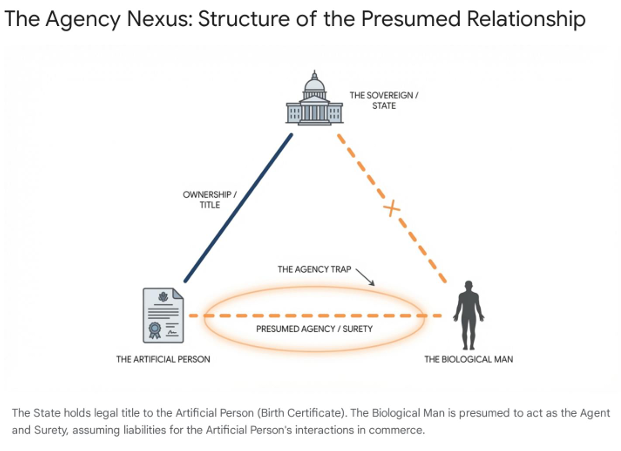
The diagram above illustrates this triangular relationship. The State interacts directly with the Artificial Person (the entity it created). The Living Man interacts with the Artificial Person as an agent. The "trap" closes when the Living Man believes he is the Artificial Person, thereby allowing the State to bypass the corporate veil and access the man's energy and labor directly.
III. The Law of Agency as the Interface
Agency is the "conceptual bridge" between the natural and the artificial. It is defined as a consensual relationship whereby one person (the agent) is authorized to act on behalf of another (the principal) and thereby affect the principal's legal position.
3.1 Elements of the Agency Relationship
For a valid agency relationship to exist, three core elements are doctrinally required:
1. Consent: Both the principal and the agent must consent to the relationship. This consent may be express or implied.
2. Authority: The agent must have authority to act. This authority can be actual (express or implied) or apparent (ostensible).
3. Capacity: The principal must have the legal capacity to enter into the underlying legal relations.
In the context of the "birth certificate construct," the element of consent is the most contentious. The "Envoy Protocol" argues that the agency relationship is typically established by presumption rather than informed consent. When a person answers to the name on the birth certificate in court or signs a document without qualification, they are deemed to have consented to act as the agent for that entity. They have validated the presumption of agency through their conduct.
3.2 Authority and the "Directing Mind"
The law recognizes different forms of authority. Actual authority arises from an express grant—for example, a board resolution appointing a director. Apparent authority, described in Freeman & Lockyer v Buckhurst Park Properties (Mangal) Ltd 2 QB 480, arises when the principal represents to a third party that the agent has authority, and the third party relies on that representation.
When a living man presents a driver's license (property of the Artificial Person) to a police officer (agent of the State), he is representing that he has the authority to operate the "player piece" (the Artificial Person). The officer relies on this representation.
This creates a binding agency relationship for that interaction. Furthermore, the "directing mind and will" doctrine, articulated in Tesco Supermarkets Ltd v Nattrass AC 153, attributes the mental state of the agent to the corporation. If the living man (agent) acts with mens rea (guilty mind), that state of mind is attributed to the Artificial Person (principal), justifying the imposition of penalties on the entity—which the man, as surety, must then pay.
3.3 The Signature by Procuration
The Bills of Exchange Act 1882 provides a critical insight into the mechanics of agency in commerce. Section 25 of the Act deals with signatures "by procuration" (per procurationem or p.p.).
"A signature by procuration operates as notice that the agent has but a limited authority to sign, and the principal is only bound by such signature if the agent in so signing was acting within the actual limits of his authority."
This provision is a double-edged sword. It confirms that it is possible for a natural person to sign for an artificial person without assuming personal liability, provided they signal the agency relationship. By signing "p.p." or "Authorized Representative," the agent gives notice that they are not the principal.
However, the vast majority of people sign documents (tax returns, traffic tickets, loan applications) without any such qualification. In doing so, they fail to invoke the protection of procuration. They sign as though they are the entity, or as an unlimited surety for it. This failure to distinguish capacity at the point of signature is one of the primary ways the "Agency Trap" is sprung.
IV. The 'Agency Trap' and the Monopoly Board Analogy
The "Agency Trap" is the mechanism by which the state pierces the separation of the Salomon principle to attach liability to the living man. This is best understood through the "Monopoly Board" analogy presented in the research material, which reframes the legal system as a game of commerce played with artificial tokens.
4.1 The Two "You's": Player vs. Player Piece
The commercial world functions like a game of Monopoly. The board represents the jurisdiction of commerce, statutory law, and public administration.
• The Player: The "Living You" (Biological Man/Woman). This is the sentient being, the source of all "credit energy" that powers the financial system. The Player exists in reality, outside the board.
• The Player Piece: The "Artificial You" (Birth Certificate Entity). This is the corporate "person," the registered estate, or the token used to traverse the board. It exists only within the legal fiction of the game.
In a standard board game, the distinction is obvious: the player moves the piece, but the player is not the piece. If the piece lands on a "Tax" square, the player pays from their funds, but the liability technically belongs to the token's position on the board. In the legal system, the "Agency Trap" collapses this distinction. The state presumes the Player is the Piece.
"The fundamental deception of the modern administrative state is the collapse of two distinct entities into one identity... The presumption of Identity... allows the state to attach all taxes, fines, and liabilities to the estate and enforce them against the living individual through presumed agency."
4.2 The Fallacy of Ownership and HJR 192
The analysis further posits that individuals do not "own" the assets registered to their Legal Person. This conclusion is drawn from the historical context of the Emergency Banking Act of 1933 and House Joint Resolution 192 (HJR 192), which suspended the gold standard and placed the United States (and by extension, the interconnected Western commercial system) into a state of bankruptcy reorganization.
In this state of perpetual bankruptcy:
1. Legal Title to all property is held by the State (the "Cabal" or Sovereign) as security for the national debt. The State is the ultimate creditor and owner of the board.
2. Equitable Title (possession and use) is granted to the Artificial Person.
3. The Living Man effectively "rents" the Artificial Person and its assets from the state.
Therefore, when a man claims, "I own this house," he is legally incorrect. His Artificial Person holds equitable title to the house, but the Artificial Person itself is the property of the State. The man is merely the surety guaranteeing the Artificial Person's performance and maintenance of the asset. This explains why the state can seize "private" property for non-payment of taxes; they are merely reclaiming the assets of their own creation (the Artificial Person) for which the living man foolishly accepted liability.
4.3 The Mechanism of Surety
The "living man" acts as surety for the "birth certificate construct." A surety is one who undertakes to pay money or perform other acts in the event that his principal fails to do so.
• The Principal is the Artificial Person (decedent estate/trust).
• The Surety is the Living Man (who mistakenly believes he is the Principal).
• The Beneficiary/Creditor is the State/Crown.
This relationship is often sealed in the courtroom. When a judge calls the name of the Artificial Person (e.g., "JOHN DOE"), and the living man stands up and answers, "I am he," he has verbally confirmed the agency relationship. He has volunteered to be the surety for the defendant named in the indictment. He has stepped into the trap. The court proceeding is not a trial of the living man's conduct; it is an administration of the Artificial Person's accounts, for which the man has just accepted responsibility.
V. Failures of the 'Truth and Freedom' Paradigm
A significant portion of the "truth and freedom" community attempts to resist this system through what is often termed "pseudo-legal" arguments or "Organized Pseudo legal Commercial Arguments" (OPCA). This report analyses why these strategies consistently fail, categorizing them as "Cargo Cult Legalism"— mimicking the forms of law without understanding the underlying mechanics of agency and capacity.
5.1 The Category Error: Fact vs. Form
The primary failure of "Freemen on the Land," "Sovereign," and similar groups is a fundamental category error regarding jurisdiction. They attempt to argue facts (biological reality, moral truth, common law rights) in a court of form (commercial agency, statutory contract, admiralty/equity).
• The "Living Man" Declaration: When a defendant declares, "I am a living man, not a person," the court views this as irrelevant. The court is adjudicating the liability of the Artificial Person (the Trust/Estate) named in the charging instrument. The judge knows the man is biological; the issue is whether he is the agent for the entity on the docket. By appearing and arguing, even to deny jurisdiction, the individual often inadvertently accepts the role of agent.
• Constitutional Arguments: Constitutional rights typically belong to "We the People" (sovereigns) or recognized citizens. However, if one appears as the surety for a bankrupt entity (the Artificial Person), one has waived those rights in favor of "privileges" granted to the entity by the state. One cannot claim sovereign rights while operating as a commercial surety for a subject entity.
5.2 Case Studies of Failure
The research material documents specific examples of failed strategies, illustrating the consequences of neglecting the agency relationship:
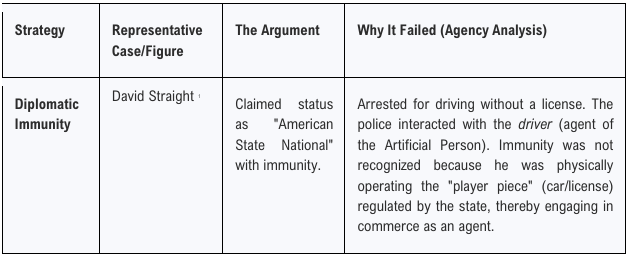
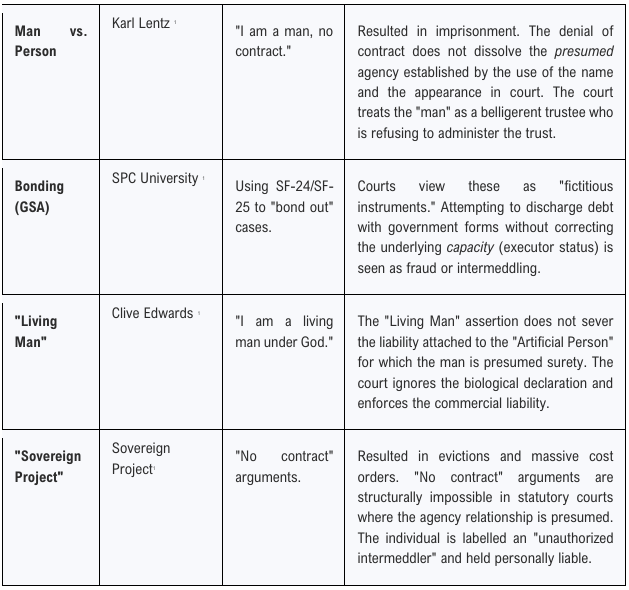
5.3 The "Belligerent Trustee"
Problem When a living man argues with the court without correcting his capacity, he is viewed as a "Belligerent Trustee" or Executor de son tort. He is effectively admitting he is holding the property/body of the Artificial Person but refusing to execute the duties (pay the fines/taxes) associated with it. The court, acting for the Beneficiary (the State), punishes the Trustee for breach of fiduciary duty. This is not a violation of the man's rights; it is the enforcement of his fiduciary obligations as the presumed agent.
"Pseudo-law attempts to defeat the system from within its own jurisdiction... Jurisdictional Retaliation: Courts predictably respond to confrontational strategies with contempt charges."
VI. The Crown as 'Executor de son tort'
To escape the "Agency Trap," one must understand the alternative: who administers the estate if the living man does not? This leads to the doctrine of executor de son tort and the role of the Crown.
6.1 The Registered Person as "Decedent Estate"
The "Envoy Protocol" posits that the registered legal person is effectively a decedent estate. The logic is as follows:
1. Registration creates a separate legal entity.
2. The living child/man is not the entity.
3. The entity creates debts and holds assets (rights).
4. Because the living man rarely claims the role of "Executor" for this entity, the system treats the entity as "abandoned" or the "estate of a decedent".
This perspective aligns with the Cestui Que Vie Act 1666, which provided that persons "lost beyond the seas" for seven years could be declared legally dead, and their estates administered by the state. The "birth certificate construct" is treated as the estate of a person who has never "come back from the sea" to claim their rights.
6.2 The Crown's Role
In the absence of a named executor who proves their life and capacity, the estate is administered by the State (the Crown). However, the Crown acts as an Executor de son tort—an "executor of his own wrong".
An executor de son tort is defined as:
"A person not lawfully appointed to deal with the estate, but who has intermeddled... and is accountable as if he/she had authority.""He who intermeddles with the estate of the deceased without title may render himself liable as executor de son tort."
This is the "trap" from the State's perspective. The State does not want to be the liable executor. It prefers to assign that role to the living man.
1. If the man stays silent: The State administers the estate (taxes, fines) but passes the liability to the man via presumed agency.
2. If the man acts as Executor de son tort: If the man uses the estate's assets (driver's license, bank account) without legal title (Executor status), he becomes the executor de son tort and is personally liable for the debts.
6.3 The Intermeddling Trap
The doctrine creates a double bind.
• The Crown: Acts as administrator by necessity but seeks to offload liability.
• The Living Man: By "using" the name (intermeddling) without asserting "Office," he accepts full liability for the estate's debts (taxes) and loses the protections of the estate (limitations of liability).
The Crown effectively says: "Since you are acting like the owner of this Name (intermeddling), you must pay its debts." This turns the living man into the surety for the Crown's creation.
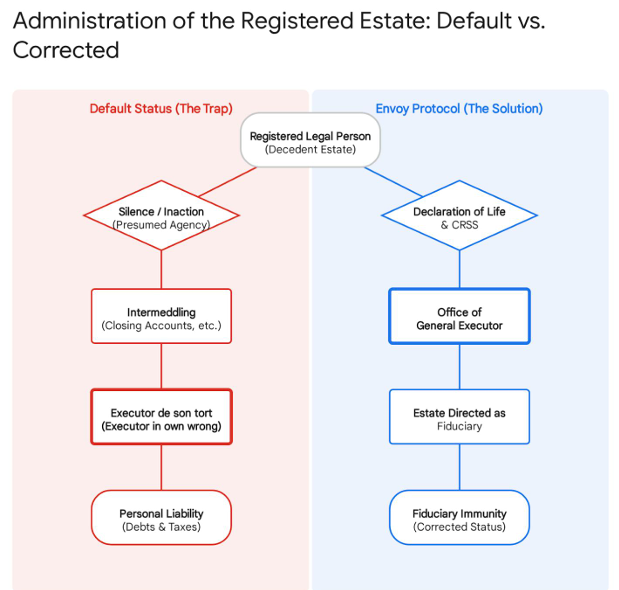

The flowchart above delineates the two distinct pathways. The default path leads to personal liability through the mechanism of intermeddling. The corrected path, utilizing the Envoy Protocol, leads to fiduciary immunity by establishing proper standing.
VII. The Envoy Protocol and Capacity Correction
The "Envoy Protocol" is presented as the solution to this agency problem. It is a capacity-based framework that does not "fight" the system but rather "corrects" the file by aligning legal capacity with function. 1 It leverages the system's own rules to achieve an exit from the "Monopoly board."
7.1 Severing Agency: Clausula Rebus Sic Stantibus (CRSS)
The first step in the protocol is breaking the presumption of agency. The protocol utilizes the international law principle of Clausula Rebus Sic Stantibus (things thus standing).
• The Argument: The agency relationship (birth certificate) was formed when the individual was an infant, without informed consent. The "fundamental circumstances" have changed (the infant is now a competent adult).
• The Effect: CRSS is used as the basis to rescind presumed agency. It asserts that the tacit agreement that the living man is the surety for the artificial person is void for want of disclosure and consent. It is an argument of equity: circumstances have fundamentally altered such that the original presumption of agency is no longer valid.
7.2 Occupying the Office of General Executor
Once agency is severed, the "abandoned" estate must still be administered (or the Crown will resume doing so). The Envoy Protocol asserts that the living man must occupy the Office of General Executor for the registered decedent estate.
This shifts the standing:
• Before: Living Man = Agent/Surety (Subject to the Estate).
• After: Living Man = General Executor (Director of the Estate).
As General Executor, the individual directs the administration of the legal person. Crucially, an executor is not personally liable for the debts of the estate provided they act within their authority and do not intermeddle The liabilities remain with the estate (the "Artificial You"), while the living man directs the settlement of those liabilities without personal attachment. This is the "proper" way to interface with the artificial person—not as its battery, but as its administrator.
7.3 The "Envoy" Declaration
The final layer of status correction is the declaration of "Envoy" status. This is asserted within an ecclesiastical or international framework.
• Purpose: To access "higher-order jurisdiction" and international human rights fora.
• Effect: It removes the individual from the "domestic" jurisdiction of the "Monopoly board" (statutory/civil law) and places them in a position of diplomatic or ecclesiastical exteriority.
"Envoy status... Reframes standing away from domestic administrative presumptions... [and] Reduces exposure to domestic statutory processes."
VIII. Commercial Mechanics of the Exit
Status correction alone is insufficient without a mechanism to handle the commercial reality of the "Artificial You's" debts and assets. This is where the Asset Fortress Protocol and Recoupment mechanisms function. The goal is to move from a defensive posture to one of "structural invincibility".
8.1 The Asset Fortress Protocol (AFP)
The "Fallacy of Ownership" 1 dictates that the registered person (birth certificate) cannot own property; it only holds equitable title subject to the State's lien. The AFP solves this by placing a New Player on the board.
• The Structure: A fiduciary trust or private entity (Foreign Grantor Trust, 98-Series Trust) is created.
• The Transfer: Assets (house, car, business) are legally transferred to this Trust.
• The Separation: The Living Man is the beneficiary, not the trustee or owner. This severs the "direct line of control" the state has over the birth certificate entity.
The State can tax the Birth Certificate Entity, but if that entity owns nothing (because assets were moved to the AFP), the liability cannot attach to the physical assets. The assets are "fortressed" in a separate jurisdiction.
8.2 Lawful Discharge and Recoupment
The protocol advocates for a "Peaceful Exit" via accounting reconciliation rather than conflict. The strategy relies on identifying banks and tax offices as "presumed nominees"—middlemen who are holding the credit generated by the living man's energy but failing to credit his account.
• Recoupment: Identifying the "Achilles' Heel" of the system, such as procedural errors or the status of banks as mere nominees.
• Instruments: Utilizing Corrective Nominee Filings (Form 1099-OID) and the Notice of Adverse Claim (UCC § 8-105). These instruments are used to correct the ledger. They assert that the "Artificial You" is the creditor, not the debtor, and that the banks/state are holding "abandoned credit" that belongs to the estate.
• The 810 Code Algorithm: A specific mechanism mentioned to transfer credits from the public ledger (IRS) to the private ledger (AFP). This suggests a sophisticated use of the tax system's own coding to effectuate a transfer of value.
By discharging liabilities using the system's own credits (what the text refers to as "abandoned credit"), the General Executor settles the estate's debts. The debt stays "on the board" with the fiction; the living man is free.
8.3 The Bills of Exchange Act 1882 and Signature Per Procurationem
A critical practical tool in this protocol is the signature. As established in Part I, the Bills of Exchange Act 1882, Section 25 provides the "kill switch" for personal liability.
When the Living Man signs a document (check, contract, court paper) for the Artificial Person, he must sign "per procurationem" (p.p.).
• Effect: This gives notice that he is an agent with limited authority.
• Result: The principal (the Artificial Person) is bound, but the agent (Living Man) is not personally liable.
By signing "p.p." or as "Authorized Representative," the individual doctrinally enforces the separation between the natural and artificial persons, preventing the "Agency Trap" from closing.
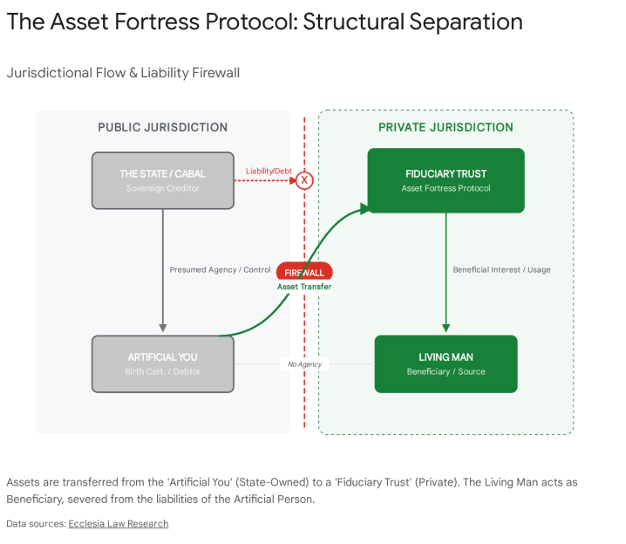
The visual above illustrates this structural separation. By moving assets across the jurisdictional barrier into the Fiduciary Trust, they are shielded from the liabilities that accrue to the Artificial Person in the Public Jurisdiction.
IX. Conclusion: The Transition from Surety to Executor
The failure of the "truth and freedom" community has historically stemmed from a misunderstanding of the battlefield. By arguing biological facts in a venue of commercial agency, they inadvertently confirm their status as sureties for the state's artificial creations. The "Agency Trap" is effective precisely because it relies on the individual's ignorance of their own capacity.
The analysis of the "Agency Trap" reveals that the Crown acts as Executor de son tort only by necessity— filling the vacuum left by the living man's failure to claim his competent office. The "Envoy Protocol" and "Asset Fortress Protocol" offer a coherent doctrinal solution to this dilemma. They do not rely on "pseudo legal" denials of jurisdiction but on the correction of capacity.
By severing the presumed agency via Clausula Rebus Sic Stantibus, occupying the Office of General Executor, and utilizing the orthodox protections of separate legal personality (Salomon) and limited signature authority (Bills of Exchange Act), the living individual transitions from a debtor pawn to a solvent creditor. The law of agency, often the trap, becomes the bridge to commercial immunity.
Key Takeaways
1. The Trap is Agency: Liability attaches to the man only because he is presumed to be the agent/surety for the Birth Certificate Entity.
2. The State is the Default Administrator: If the man does not act as Executor, the Crown must intermeddle (Executor de son tort) to administer the estate.
3. Orthodoxy is the Key: Solutions must use established legal principles (Salomon, p.p. signatures, Trust law) rather than "sovereign" rhetoric.
4. Commerce Requires Separation: The Asset Fortress Protocol separates the man from the liability by placing a "New Player" (Trust) on the board to hold assets.
This report demonstrates that the path to "truth and freedom" in a commercial world lies not in the rejection of the legal persona, but in the mastery of its administration.
Works cited
1. Agency Between Natural and Artificial Persons in English Law.pdf
2. VATREG02100 - Basic principles of registration: meaning of person - HMRC internal manual, accessed February 13, 2026, https://www.gov.uk/hmrc-internal-manuals/vat-registration manual/vatreg02100
3. Interpretation Act 1978 - Legislation.gov.uk, accessed February 13, 2026, https://www.legislation.gov.uk/ukpga/1978/30
4. Interpretation Act 1978 UK - CommonLII, accessed February 13, 2026, http://www.commonlii.org/bm/legis/consol_reg/ia1978u221.pdf
5. Salomon v Salomon Case Summary A Corporate Law Deep Dive - Draft Bot Pro, accessed February 13, 2026, https://www.draftbotpro.com/post/salomon-v-salomon-case-summary-a corporate-law-deep-dive
6. Salomon v Salomon - Case Summary | LawTeacher.net, accessed February 13, 2026, https://www.lawteacher.net/cases/salomon-v-salomon.php
7. Salomon v A Salomon & Co Ltd - Wikipedia, accessed February 13, 2026, https://en.wikipedia.org/wiki/Salomon_v_A_Salomon_%26_Co_Ltd
8. The Corporate Veil | Gibson Sheat, accessed February 2026, https://www.gibsonsheat.com/Articles/Corporate++Commercial/The+Corporate+Veil.html 13
10. Law of agency - Wikipedia, accessed February 13, 2026, https://en.wikipedia.org/wiki/Law_of_agency
11. Bills of Exchange Act 1882 - Legislation.gov.uk, accessed February 13, 2026, https://www.legislation.gov.uk/ukpga/Vict/45-46/61/section/25
12. Bills of Exchange Act 1882 - Legislation.gov.uk, accessed February 13, 2026, https://www.legislation.gov.uk/ukpga/Vict/45-46/61
13. Bills of Exchange Act ( RSC , 1985, c. B-4) - Department of Justice Canada, accessed February 13, 2026, https://laws-lois.justice.gc.ca/eng/acts/b-4/fulltext.html
14. Cestui Que Vie Act 1666 - Legislation.gov.uk, accessed February 13, 2026, https://www.legislation.gov.uk/aep/Cha2/18-19/11
15. Cestui Que Vie Act 1666 Lost Beyond The Seas | PDF - Scribd, accessed February 13, 2026, https://www.scribd.com/document/46799976/Cestui-Que-Vie-Act-1666-Lost-Beyond-the Seas
16. Estate Administration and Intermeddling Executors – what can you do?, accessed February 13, 2026, https://www.shma.co.uk/our-thoughts/estate-administration-and-intermeddling executors/
17. Deceased debtors and the position of intermeddlers - J&P Credit Solutions - Specialist Debt Recovery Solicitors, accessed February 2026, https://www.jpcreditsolutions.co.uk/resources/blog/deceased-debtors-and-intermeddlers/