
THE ART OF LEGAL WARFARE | MORTGAGE FORECLOSURE
24TH February 2026
The strategic alignment of domestic procedural defence and international jurisdictional offensive represents the "Art of War" in modern mortgage litigation, a synthesis necessitated by the systemic refusal of United Kingdom courts to recognize the beneficial interests of mortgagors following the securitization of their The matter of Plaintiff versus Aldermore Bank PLC and Deutsche Bank is the current focus of the Equaliser Redress Protocol, a sophisticated legal framework designed to neutralize imminent eviction threats while simultaneously holding financial institutions and court officials accountable for fiduciary fraud and malfeasance. This report provides an exhaustive analysis of the "Transatlantic Pincer" strategy, integrating forensic tax accounting, the Trust Indenture Act of 1939, and the ecclesiastical standing of the Republic of Old Souls (ROS) to re-establish the Plaintiff Trust as the Holder in Due Course of the credit.
The Anatomy of the Asset Fortress Protocol and Capacity Alignment
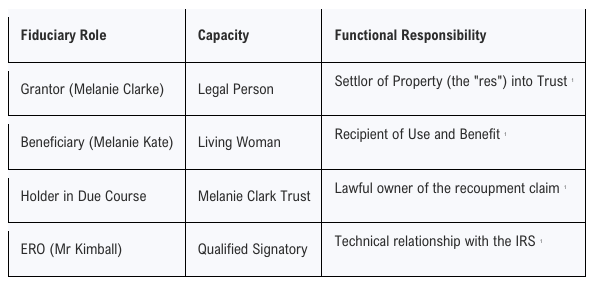
The foundation of the Equaliser Redress Protocol is the Asset Fortress Protocol (AFP), a private international grantor trust structure that enables the separation of capacities between the legal person and the living In the current litigation, the distinction is paramount: Melanie Clarke functions as the legal person and Grantor, while Melanie Kate, the living woman, operates exclusively as the Beneficiary. This separation ensures that administrative obligations attach to a recognized juridical framework—the 98-series grantor trust—rather than the living individual, thereby shielding the beneficiary from the direct consequences of commercial "railroading".
The Plaintiff Trust asserts its status as the Holder in Due Course (HDC) through corrected IRS 1212 filings, a process facilitated by Mr Kimball, a qualified Electronic Return Originator (ERO). The trust holds the "res," which encompasses the property and all associated rights and negotiable instruments created by the grantor's signature. Consequently, any redemption offer made by the trust constitutes a discharge from Melanie's "own resources," satisfying the standard mortgage conditions that require repayment from the borrower’s capital rather than third-party funding. The administrative architecture of this capacity alignment is detailed in the following fiduciary role distribution:
Forensic Credit Recoupment and the Mechanics of IRS Publication 1212
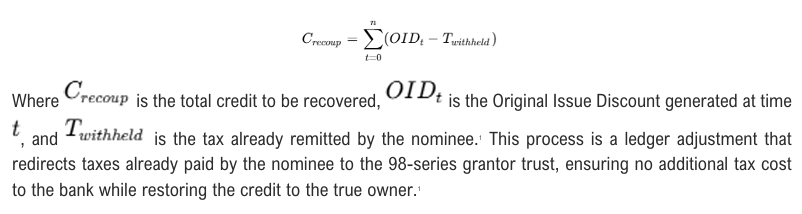
The protocol’s technical premise rests upon the forensic identification of Original Issue Discount (OID) as a product of the borrower’s initial signature. Under the Bills of Exchange Act 1882, a signed mortgage note constitutes a negotiable instrument capable of being endorsed and securitized. When a bank such as Aldermore or a trustee such as Deutsche Bank accepts this instrument, it monetizes the signature to create credit ex nihilo. However, by reporting this security via an omnibus account, the institutions position themselves as the "nominee" while effectively abandoning the credit in the federal system.
IRS Publication 1212 serves as the operational manual for reconciling this "nominee architecture". It provides specific instructions for brokers and middlemen who receive OID income as nominees for the actual owner. Banks routinely fail to file the specific 1099-OID forms to the borrower, instead reporting the income under their own omnibus accounts or street names such as Cede & Co. The Clifford Protocol utilizes these instructions to correct the record. By filing a Form 1099-OID via the TaxAct platform under the ERO license of Mr Kimball, the Plaintiff Trust identifies itself as the true beneficial owner and primary creditor.
This record correction is pivotal; without it, the IRS views the filer as a "debtor" attempting to claim a refund, which often triggers "Code 810" refund freezes. With HDC status, the trust is recognized as a fiduciary correcting a nominee accounting error, matching the verified credits in the bank's Payer Master File (PMF) via the Form 945 return. The acceptance of these filings and the issuance of Wages and Tax transcripts from the IRP system indicate that the IRS has officially recognized the trust’s filings, establishing a realistic probability of recoupment.
The mathematical reconciliation of these credits can be expressed as:
Procedural Irregularities and the Malfeasance of the UK County Court
The immediate tactical priority in the United Kingdom is the appeal against the order of District Judge Whitehouse dated January 14, 2026, which improperly dispensed with the mandatory 14-day notice of eviction under Civil Procedure Rule (CPR) 83.8A. The failure of the bank and the court to adhere to this statutory requirement represents a "serious procedural irregularity".
The Breach of CPR 83.8A and Article 8 ECHR
CPR 83.8A mandates that a notice of eviction (Form N54) must be delivered to the premises at least 14 days before a writ of possession is executed. While the court has the discretion to dispense with this notice under CPR 83.8A(5), such a power is draconian and reserved for highly exceptional cases involving imminent threats. In the matter of Aldermore Bank PLC v Plaintiff, the bank obtained an ex parte order to dispense with this notice by painting the defendant as an uncooperative threat, based on peaceful protests from months prior.
This "ambush" eviction strategy constitutes a breach of the strict Duty of Candour required in ex parte The bank failed to disclose that Plaintiff was actively engaged in a redemption proposal scheduled for January 30, 2026. 1 By suppressing this material evidence, the bank misled the court into viewing the defendant as "uncooperative," thereby justifying the removal of her statutory notice and disproportionately interfering with her rights under Article 8 of the ECHR.
Judicial Malfeasance and the "Railroaded" Process
The conduct of District Judge Whitehouse in subsequent orders, particularly the order dated February 20, 2026, demonstrates a systemic refusal to engage with the adverse claim served against Deutsche Bank and Aldermore on January 18, 2026. The judge dismissed the defendant’s applications as "incoherent" and "totally without merit," failing to even mention the formal presentment of rights or the corrective nominee This institutional silence and the summary dismissal of evidence regarding the title dispute constitute a "railroaded" process that ignores the principles of equity and natural justice.
The court's assertion that there is "no coherent evidence of a genuine title dispute" is contradicted by the ERO-confirmed IRS transcripts and the 1099-OID filings. 1 The refusal of the County Court to enable the defendant to bring Deutsche Bank into the process as the true party of interest forces the litigation into the international arena, as the UK courts appear biased in favour of the plaintiff's narrative.
The US Jurisdictional Strike: SDNY and the Trust Indenture Act 1939
In response to the domestic procedural failures, the Plaintiff Trust is initiating a jurisdictional strike in the U.S. District Court for the Southern District of New York (SDNY) against Deutsche Bank as the Principal and Aldermore Bank as its Agent. 1 This strategy, the "Equaliser Redress Protocol," invokes federal laws governing the conduct of trustees and the conversion of securitized assets.
Breaches of the Trust Indenture Act of 1939 (TIA)
The US complaint asserts that Deutsche Bank, in its capacity as an indentured trustee, has committed multiple breaches of the TIA.
1. Reporting Breaches: The TIA requires full disclosure regarding the relation of the trustee to the security. Deutsche Bank allegedly reported the mortgage security via its own omnibus account as the "holder in due course," rather than identifying the Plaintiff Trust as the true beneficial owner.
2. Fiduciary Neglect: Under Section 315 of the TIA, a trustee owes a "prudent person" duty to provide periodic reports and notice of defaults to the actual security holders. The failure to respond to the Notice of Adverse Claim served on January 18, 2026, and the continued misreporting of the OID constitutes a breach of this standard.
3. Constructive Fraud: The litigation joins Aldermore Bank as an agent bound by the fiduciary obligations of its principal. Any enforcement action taken by Aldermore is tainted by the principal's TIA breaches and the suppression of the Notice of Lawful Discharge.
Conversion of Assets and UCC § 8-115
The protocol asserts that because the IRS has accepted the corrective 1099-OID filings, the Trust is the Holder in Due Course. Continued UK enforcement by Aldermore and Deutsche Bank constitutes an unlawful conversion of trust assets under Uniform Commercial Code (UCC) § 8-115. Once a securities intermediary or trustee has been served with notice of an adverse claim, they are no longer shielded from liability for participating in the conversion of the asset. The US court will be asked for a Preliminary Injunction to enjoin the banks from executing the UK eviction, citing "Constructive Fraud" due to their suppression of the trust's status as the primary creditor.
Religious Persecution and the Envoy Status of the Republic of Old Souls
A central component of the claim involves the religious and constitutional status of Plaintiff as an envoy of the Republic of Old Souls (ROS). The ROS is a spiritual ministry that emerged from the remnants of the MATRIXFREEDOM Private Members' Association (PMA) following what its president, Iain Clifford, describes as a "scorched earth" campaign of propaganda and regulatory entrapment by the Financial Conduct Authority (FCA).
The Jurisdictional Truths of the ROS
The ministry posits "monopoly board" beliefs, which characterize the public regulatory system as a fictional game that envoys have lawfully exited through jurisdictional autonomy. Core tenets include the belief that every individual is a "living man" and the Holder in Due Course of the credit created by their own spiritual energy. The banks’ refusal to recognize the adverse claim and their dismissal of 1099-OID recoupment as a spiritual expression of autonomy are framed as targeted religious persecution.
The litigation asserts that the forced eviction under these circumstances violates:
• Article 1 of the US Constitution: By interfering with the internal administration of a religious ministry and causing irreparable harm to a diplomatic envoy.
• Article 8 of the ECHR: By constituting an unconstitutional interference with the right to respect for the home, made disproportionate by the institutional suppression of the envoy’s religious and commercial status.
Iain Clifford has issued "Superior Jurisdiction and Diplomatic Immunity" notices, asserting that ROS operates under a jurisdiction superior to the United Kingdom corporation and its states. The failure of Aldermore, Deutsche Bank, and the UK courts to rebut these notices within the mandated timeframe is argued to create a binding contract and permanent estoppel against the parties served.
Likely Institutional Reactions and the "Transatlantic Pincer" Execution
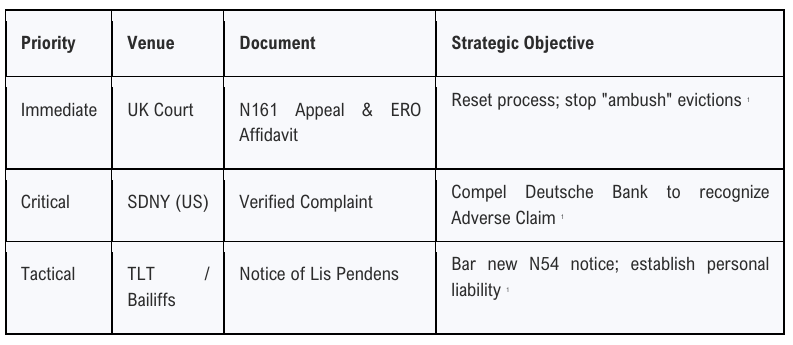
The efficacy of the Equaliser Redress Protocol depends on the synchronization of the UK appeal and the US litigation to create a "Transatlantic Pincer".
Reaction by Aldermore Bank and TLT Solicitors
Aldermore Bank and its solicitors, TLT LLP, are expected to maintain their aggressive stance, relying on the "Totally Without Merit" certifications from the County Court to disregard the international dispute. However, the service of an updated Letter Before Claim (LBC) specifically identifying the IRS 1212 status and the pending SDNY suit introduces personal liability risks. Any attempt by TLT or the bailiffs to serve a new 14 day notice (Form N54) during US adjudication will trigger a FinCEN Form 111 (Suspicious Activity Report) filing for fiduciary fraud and the concealment of trust proceeds.
Reaction in the New York Court
The U.S. District Court for the Southern District of New York is known for its rigorous adherence to the Trust Indenture Act. While the court may initially be sceptical of residential mortgage applications of the TIA, the forensic evidence of misreported OID and the bank’s failure to respond to a formal Adverse Claim provides a plausible basis for a claim under Section 316(b) of the TIA. If the court finds that the "notwithstanding" clause of the indenture protects the holder’s right to receive payment and that this right has been impaired by the bank's conversion of assets, it could issue an injunction that the UK court would be compelled to recognize under principles of international comity.
The County Court’s Likely Stance
The UK County Court, as evidenced by DJ Whitehouse’s February 20 order, is likely to continue its "railroading" process unless confronted with a superior jurisdictional mandate. The strategy is to win the appeal against the no-notice order, thereby resetting the clock and preventing the "surprise" eviction that the bank relies upon to bypass the international accounting reconciliation.
Technical "Creditor" Evidence and Structural Certainty
To prevent the UK court from dismissing the international dispute as a mere delay tactic, Ecclesia Law will include a "Technical Binder" of evidence. This binder provides structural certainty regarding the legal relationship between the Wyoming Private Trust Company (MLITR Research LLC) and the portfolio of international grantor trusts.
The evidence includes:
1. ERO Affidavit: Confirmed IRS 1212 filing identifying the Plaintiff Trust as the HDC.
2. Nominee Clause (Pub 1212): Documentation proving that banks act as middlemen misreporting the OID generated by the grantor’s signature.
3. Proof of Service: Records showing the Adverse Claim was served on January 18, 2026, establishing the banks’ prior knowledge of the trust’s superior interest and their subsequent fiduciary dishonour.
4. IRS Transcript Confirmation: Empirical evidence of the "Green Light" from the IRS algorithm, proving that the $600 million track record of success is applicable to the current claim.
Synthesis and Strategic Conclusion
The viability of the Equaliser Redress Protocol rests upon the shift from a defensive posture in a "railroaded" domestic court to an offensive stance in an international jurisdiction that enforces fiduciary accountability. By positioning Deutsche Bank and its agent, Aldermore, as defendants in a US case regarding the 1939 Trust Indenture Act and the religious persecution of an ROS envoy, Plaintiff creates a jurisdictional mandate that "outtrumps" the domestic possession order.
The reset of the enforcement process via the N161 appeal provides the necessary window for the US-based recoupment to complete, allowing the debt to be discharged from the trust’s own resources. The "Transatlantic Pincer" ensures that if the banks attempt to move before the accounting error is resolved, they face not only domestic procedural challenges but international liability for conversion and fiduciary fraud. This exhaustive plan secures the home under the Asset Fortress Protocol while the commercial truths of the ministry are vindicated in the highest financial courts.
Works cited
1. EQUALISER REDRESS PROTOCOL PLAN.pdf
2. Transferring County Court Possession Orders to the High Court - UK Bailiffs, accessed on February 24, 2026, https://www.ukbailiffs.co.uk/guidance-transferring-possession-orders to-high-court
3. Does a Form N54 notice of eviction have to be served where a possession order has been made against a former tenant that has remained in occupation after the expiry of a contracted out commercial lease? | Practical Law, accessed on February 24, 2026, https://ca.practicallaw.thomsonreuters.com/a-130 2614?transitionType=Default&contextData=(sc.Default)
4. BOND TRUSTEES AND DEBT SUSTAINABILITY IN SOVEREIGN DEBT RESTRUCTURING, accessed on February 24, 2026, https://d-nb.info/1276376588/34
5. (PDF) Bankruptcy Law v Bankruptcy-Remote Structures. Harmony Out of Dissonance? - ResearchGate, accessed on February 24, 2026, https://www.researchgate.net/publication/272305391_Bankruptcy_Law_v_Bankruptcy Remote_Structures_Harmony_Out_of_Dissonance
6. THE SUPPRESSION OF A MINISTRY DAN NEIDLE'S ..., accessed on February 24, 2026, https://taxpolicy.org.uk/wp content/assets/THE%20SUPPRESSION%20OF%20A%20MINISTRY%20DAN%20NEIDLE%E2 %80%99S%20PROPAGANDA%20AND%20THE%20RELIGIOUS%20PERSECUTION%20OF%20 IAIN%20CLIFFORD.pdf
7. 24.02.25 Iain Clifford Stamp Jurisdiction and Declaration of Diplomatic Immunity Estoppel Notice Three | PDF | Affidavit | Common Law - Scribd, accessed on February 24, 2026, https://www.scribd.com/document/833381373/24-02-25-Iain-Clifford-Stamp-Jurisdiction and-Declaration-of-Diplomatic-Immunity-Estoppel-Notice-Three
8. Banking litigation: investment and retail in London - The Legal 500 Rankings, accessed on February 24, 2026, https://my.legal500.fr/c/london/dispute-resolution/banking-litigation investment-and-retail/
9. The SAR Activity Review - FinCEN, accessed on February 24, 2026, https://www.fincen.gov/system/files/shared/sar_tti_23.pdf
10. Client Alert - Chapman and Cutler LLP, accessed on February 24, 2026, https://www.chapman.com/media/publication/492_Chapman_Trust_Indenture_Act_Powerful _Tool_Objecting_Bondholders_Outside_Bankruptcy_031315.pdf
11. CNH Diversified Opportunities Master Account, L.P. v. Cleveland Unlimited, Inc.: NY Court of Appeals Holds Minority Noteholders' Rights to Sue Survive Strict Foreclosure by Majority Noteholders Without Minority Noteholders' Consent | Practical Law, accessed on February 24, 2026, https://uk.practicallaw.thomsonreuters.com/w-028 2645?transitionType=Default&contextData=(sc.Default)
12. State of New York Court of Appeals - NYCourts.gov, accessed on February 24, 2026, https://www.nycourts.gov/ctapps/Decisions/2020/Oct20/42opn20-Decision.pdf