“I AM A LIVING SOUL UNDER GOD THE STATE HAS NO JURISDICTION OVER ME!”
A CRITICAL ANALYSIS OF CLIVE EDWARDS AND THE CAPILLARY WAVE
14th February 2026
The rise of contemporary sovereign-adjacent movements within the United Kingdom and broader Commonwealth jurisdictions represents a profound shift in the socio-legal landscape. Central to this phenomenon is the emergence of "pseudo-legal" gurus who claim to have uncovered a hidden layer of law that immunizes the individual from the administrative mandates of the state. One of the most prominent voices in this milieu is Clive Edwards, whose platform, the Capillary Wave, posits that the modern citizen is ensnared in a fraudulent "legal" paradigm that can only be escaped through the reassertion of a "lawful" identity rooted in Biblical authority and natural rights. This report provides an exhaustive analysis of the Capillary Wave ideology, examining its core tenets, its interpretation of statutory and historical law, its perceived "successes," and the fundamental structural flaws that render it ineffective—and often dangerous—within the context of the modern judicial system.
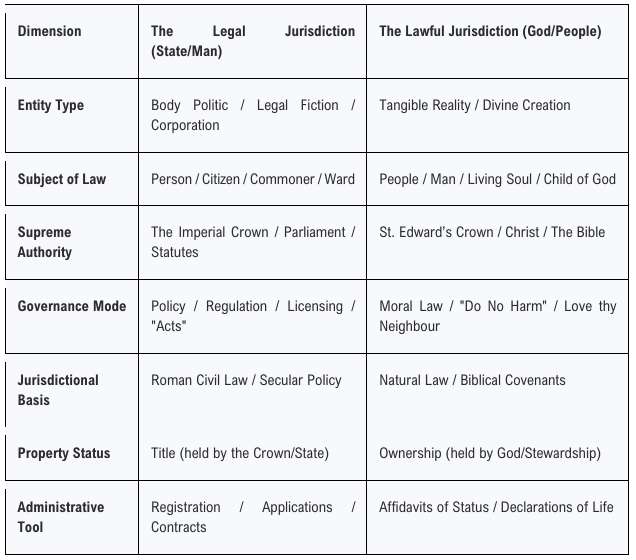
The ideological framework of the Capillary Wave rests upon a binary view of governance, which Edwards terms "The Paradigm". According to this worldview, every individual exists in one of two positions: either as a "people under God" in the highest possible standing on earth, or as a "citizen" or "electorate" in the lowest possible position within a country. 1 This bifurcation is not merely a moral or spiritual distinction but is presented as a functional jurisdictional reality that governs every interaction between the individual and Edwards argues that the "United Kingdom" is not a tangible reality but a "body politic"—a legal fiction or corporate entity that exists only in the minds of those who believe in it. Conversely, he asserts that "Britain" is the physical landmass created by divine authority, and the "people" who reside upon it are subject only to "God’s Law" as found in the Authorized King James Version (KJV) 1611 Bible.
The validity of this ideology is frequently supported by Edwards' personal narrative, specifically his claim to have built a farm in Somerset without planning permission despite facing nine indictable offenses and multiple enforcement notices. He asserts that by understanding the "mechanisms of control" and challenging the council's jurisdiction through the application of Biblical maxims, he forced the authorities to abandon their prosecution. However, an examination of this claim reveals a recurring theme in the pseudo law community: the conflation of administrative pragmatism with legal victory. Local authorities often decline to prosecute individuals not because their jurisdictional arguments are valid, but because the cost of litigation against a highly litigious and non-compliant defendant exceeds the available resources or the perceived public benefit. This "administrative retreat" is then rebranded by the individual as a successful "defeat of the system," providing a false sense of security to others who might attempt similar acts of defiance.
Table 1: Jurisdictional Foundations of the Capillary Wave Paradigm
The Ontological Argument: Personhood as a Legal Fiction
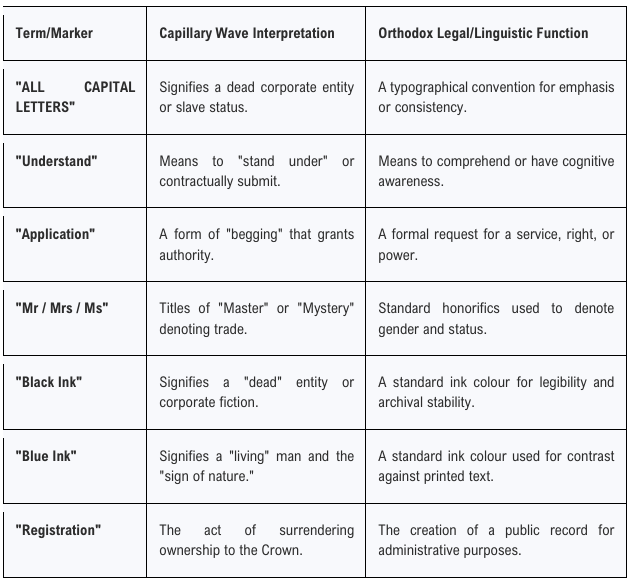
At the heart of the Capillary Wave’s critique of the state is the "Strawman" theory, which posits that the administrative state operates through the creation of a "legal fiction" known as the "person". Edwards argues that the state distinguishes between the "living man" or "living woman" and the "statutory person" through linguistic and typographical markers. A primary claim is that the use of all-capital letters for a name on a birth certificate, driver’s license, or court summons signifies a "body corporate" or a "dead entity" (CAPITIS DIMINUTIO MAXIMA), which is legally distinct from the flesh-and-blood human being.
This distinction is central to the movement’s understanding of "joinder"—the process by which a living individual is allegedly tricked into accepting the liabilities of the artificial person. Edwards asserts that whenever an individual answers to a court summons addressed to "MR. JOHN DOE," or signs an application form in black ink using block capitals, they are voluntarily "acting" as the corporate entity, thereby granting the state jurisdiction over them. This belief is supported by a selective reading of the Interpretation Act 1978 and its predecessors, which state that the term "person" includes bodies corporate.
However, the fundamental flaw in this ontological argument is a profound misunderstanding of the nature of legal personality. In orthodox law, "personality" is not a statement of biological essence but a functional status that enables the law to assign rights and duties. The distinction between "natural persons" (humans) and "artificial persons" (corporations) exists to facilitate commerce and civil governance, but it does not create a "secret" parallel identity that the state uses to commit fraud. Courts across the United Kingdom, Canada, and Australia have repeatedly dismissed "Strawman" arguments as "frivolous and vexatious," noting that a human being cannot opt out of statutory obligations by simply declaring themselves "not a person".
The ideology further misinterprets historical legal concepts such as "attornment" and "vows". Edwards argues that the act of voting is a "vow" to a secular deity (the government) and constitutes an "attornment"— a transfer of allegiance from God to man. This interpretation is used to justify the rejection of the Representation of the People Act 1867, which the movement claims "re-presents" the people as persons, thereby stripping them of their natural rights and placing them in the "lowest tier" of society: that of the commoner. This rhetorical strategy exploits the linguistic ambiguity of legal terms to create a narrative of spiritual and legal bondage that resonates with individuals feeling marginalized by modern bureaucracy.
Table 2: Linguistic and Stylistic Markers in Pseudo-Legal Theory
The Failure of Case Studies: Somerset Farm and the Fidler Castle
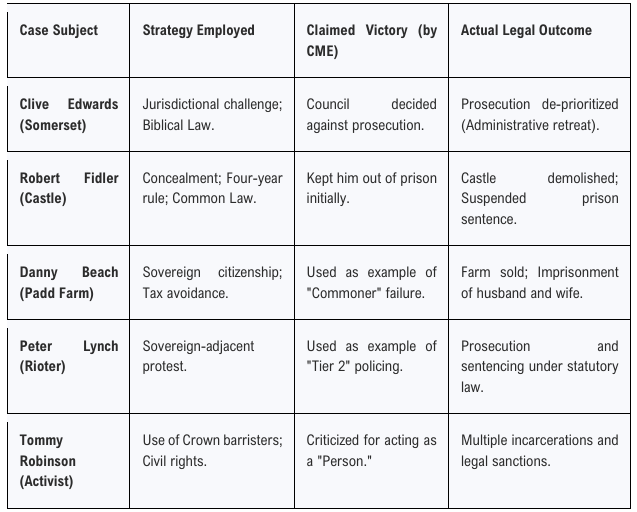
The perceived effectiveness of Capillary Wave ideologies often rests on high-profile planning cases where individuals have successfully resisted enforcement for significant periods. Edwards frequently cites his involvement in the case of Robert Fidler, the Surrey farmer who built a "castle" behind a screen of hay bales in 2002 and attempted to hide it for four years to gain immunity from planning enforcement. Edwards claims to have "kept Mr. Fidler out of prison" during a committal hearing brought by Reigate and Banstead Borough Council.
While it is true that Edwards may have assisted in delaying Fidler's incarceration, the ultimate outcome of the case serves as a devastating rebuttal to the efficacy of Capillary Wave strategies. The High Court and the Court of Appeal consistently ruled against Fidler, concluding that the act of concealment (the hay bales) was an integral part of the building operation, and therefore the four-year rule for immunity did not apply. Fidler’s reliance on "common law" arguments and jurisdictional challenges did not prevent the eventual demolition of his home.
Similarly, the case of Danny Beach and Padd Farm illustrates the catastrophic risks associated with these Beach followed sovereign-adjacent arguments in his battle against Runnymede Council, which resulted in the loss of his farm, the seizure of his assets, and his eventual imprisonment alongside his wife. Edwards characterizes these outcomes as a failure of the individuals to "change their legal status" or "understand the paradigm," rather than a failure of the ideology itself. This "no true Scotsman" fallacy allows the movement to maintain its internal consistency by blaming the victim’s "ignorance" for the state’s inevitable use of force.
The Somerset farm "victory" claimed by Edwards must also be scrutinized through the lens of administrative Planning enforcement is a discretionary power exercised by local councils. If a defendant is particularly disruptive, uses complex pseudo-legal arguments, or appears to have no assets that can be easily seized to cover legal costs, the council may decide that proceeding is not in the "public interest". This is an exercise of pragmatism, not a concession of legal authority. By presenting these administrative de prioritizations as "legal wins," the Capillary Wave ideology creates a false template for resistance that leaves others vulnerable to severe penalties when they encounter a council that is better funded or more determined to set a precedent.
Table 3: Comparative Outcomes of Planning Defiance Cases
Structural Critiques from within the "Freedom" Movement
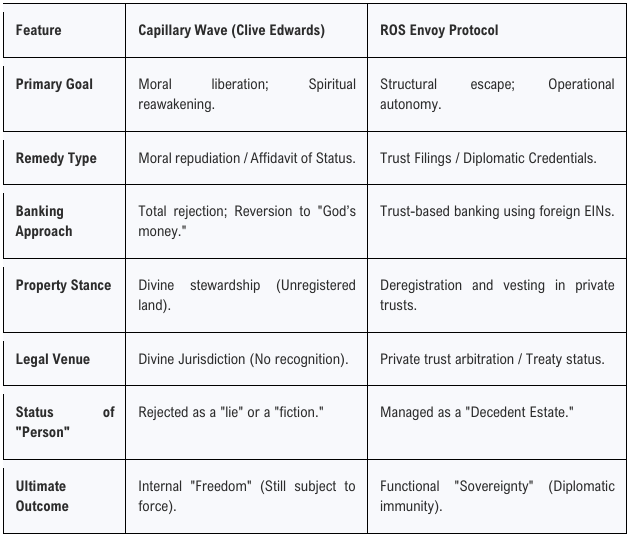
A significant indicator of the "fundamental flaws" in the Capillary Wave ideology is found in the critiques levelled against it by other groups within the sovereign-adjacent and pseudo-law communities. Proponents of the "Republic of Old Souls" (ROS) and the "Envoy Protocol" argue that Edwards' focus on "moral sovereignty" and spiritual withdrawal is functionally useless because it provides no institutional alternative to the state structures it rejects.
The ROS critique identifies three primary deficiencies in the Capillary Wave model:
1. Resistance vs. Replacement: The Capillary Wave offers a narrative of "moral reformation" but lacks the administrative machinery to function independently of the state. 1 Edwards warns that systems like digital identity are enslavement but offers no functional alternative for those who wish to exit the system while still living in a modern society.
2. The "Executor" Flaw: According to the "Envoy Protocol," the statutory person (the "NAME") is a "decedent estate" or a trust created by the state. 1 If a man declares he is "not a person" but fails to assume the "Office of General Executor" for that estate, the state remains the "executor de son tort"— an executor by its own wrong—and continues to administer the person's liabilities. Edwards’ approach of mere "withdrawal" is seen by ROS as leaving the estate unmanaged and vulnerable to state intervention.
3. Financial and Operational Impotence: The Capillary Wave suggests that individuals should simply "reject system banks" and view debt as "spiritual bondage". ROS critics argue that this provides no "worldly remedy" for financial strife. In contrast, the ROS model proposes "trust-based banking," "administrative recoupment," and the use of "foreign EINs" to create a parallel financial jurisdiction.
This internecine conflict reveals that even those who share Edwards' premise—that the state is a fraudulent corporation—recognize that his "Biblical" and "Common Law" arguments are structurally inadequate for navigating a modern legal system. The Capillary Wave is characterized as a "philosophical" protest that ignores the "procedural" requirements of law.
Table 4: Structural Comparison: Capillary Wave vs. ROS Envoy Protocol
The "Common Law Trap": Edwards’ Critique and its Internal Paradox
A notable component of Edwards’ teaching is his dismissal of other sovereign-adjacent groups, such as the "Freemen on the Land," as being caught in what he calls the "Common Common Law Trap". He argues that these groups use "Common Law" to mean something entirely different from what it is in the English legal tradition. Edwards correctly identifies that "Common Law" is, in fact, "case law" administered by the judiciary and overseen by Parliament. He further asserts that "Common Law" is the law of "commoners"—those who have voluntarily entered the "House of Commons" jurisdiction by registering to vote and accepting state benefits.
This critique creates a significant paradox within Edwards’ own ideology. He argues that by claiming "Common Law rights," an individual is unwittingly confirming their status as a "commoner" and a "citizen," which he defines as the lowest possible legal rank. However, Edwards himself relies on the same literalist and idiosyncratic interpretation of archaic legal maxims that he criticizes in others. He eschews "Common Law" for "God’s Law," yet he uses the same "pseudo-legal" toolkit—relying on obsolete law dictionaries (Black's Law 4th Ed.), selectively citing historical acts (Confession of Faith 1560), and emphasizing the "metaphysical" power of ink colours and all-caps names.
The Bible as a Legal Instrument: Historical and Modern Realities
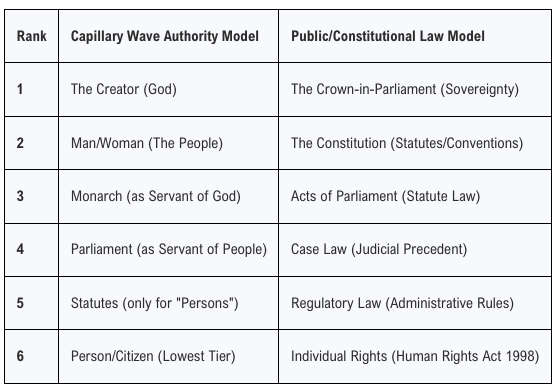
The unique selling point of the Capillary Wave is its assertion that the Authorized King James Version (KJV) 1611 Bible is the "highest authority on the law" in the United Kingdom. 1 Edwards points to the Coronation ceremony, the prayers before Parliament, and the oaths sworn by judges and police as evidence that the entire state structure is "Biblical all the way through". 1 He specifically cites the Confession of Faith Ratification Act 1560, which he claims makes the Bible the "infallible truth" of the land.
This reliance on "The Book" involves a series of interpretive errors that ignore centuries of constitutional development:
1. The Nature of Infallibility: While the 1560 Act may use the term "infallible," in a legal context, this refers to the status of the doctrine within the established church, not the applicability of specific verses to bypass modern statutory obligations. A judge’s oath to God is a "solemn appeal to a deity" intended to bind their conscience, not a commitment to override the Human Rights Act 1998 or the Traffic Management Act 2004 with citations from Leviticus.
2. The "Two Crowns" Fallacy: Edwards’ interpretation of the King's dual crowns as representing two separate functional jurisdictions is historically and legally incorrect. St. Edward's Crown is used for the act of crowning to represent the ancient traditions of the monarchy, while the Imperial State Crown is the working crown used for state occasions like the Opening of Parliament. The transition between crowns is a matter of protocol and material comfort (St. Edward's is much heavier), not a shift between "God's jurisdiction" and "Man's jurisdiction".
3. The "No Respecter of Persons" Maxim: Edwards frequently cites the Biblical phrase "God is no respecter of persons" (Acts 10:34) and the fact that Judge Brett Kavanaugh swore an oath to be "no respecter of persons" as evidence that judges should ignore the "legal fiction" of the defendant. In reality, this phrase in a legal context is a guarantee of "equality before the law"—that a judge will treat every individual fairly regardless of their social status or rank, not that they will recognize a "Strawman" argument.
By treating the Bible as a "code book" for legal loopholes, the Capillary Wave ideology commits what scholars call "Cargo Cult Legalism"—mimicking the archaic language and symbols of the state without understanding the underlying mechanics of public law and administrative procedure.
Table 5: Hierarchy of Authority according to Capillary Wave vs. Public Law
Psychological and Social Implications: The "God Delusion" and Isolation
The dissemination of Capillary Wave ideologies poses significant psychological and social risks to those who adopt them. Edwards refers to the "Atheist Delusion," arguing that those who reject God automatically become "third-class citizens" of a secular polity. 1 He labels "government" as a system of "mind control" (Govern-men-t) designed for "unruly children" who do not know God.
This rhetoric fosters a profound sense of alienation from society. Individuals are encouraged to view themselves as "diplomats from a micronation" or as "living souls" who are superior to the "commoners" This often leads to the breakdown of relationships with family and friends who do not share the ideology. Edwards himself admits to having "heated discussions" and having to "mentally wrestle" with his own perceptions of the world.
The movement also relies on a high degree of "cognitive dissonance". Adherents are told that the system is "fictional" and "not real," yet they are forced to deal with the very real consequences of bailiffs, police raids, and court sanctions. When these "realities" clash, the movement provides a scapegoat: the "corruption" of the state or the individual’s own failure to "be precise in their understanding". This creates a self-perpetuating loop where failures are never attributed to the ideology itself, but to an ever-narrowing set of procedural "mistakes" that the adherent must work to correct.
Furthermore, the "Common Law Court" established by individuals like John Smith exemplifies the dangers of parallel "pseudo-judicial" structures. These "courts" have no legal authority, yet they issue "orders" and "judgments" that can mislead individuals into believing they have a valid defence against the state. When these judgments are ignored by official bodies, the adherents become increasingly radicalized, viewing the state as an inherently "immoral" and "criminal" entity.
Synthesis of Fundamental Flaws
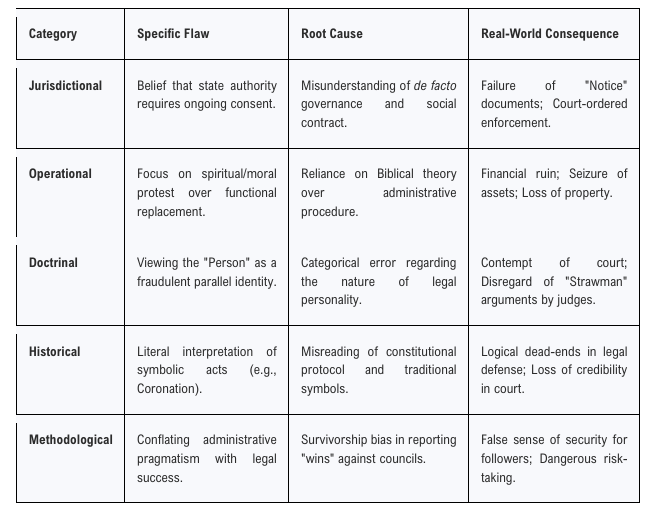
The analysis of Clive Edwards and the Capillary Wave content reveal several categorical flaws that invalidate the ideology as a viable means of legal or social navigation. These flaws are not merely errors in detail but are foundational misapprehensions of the social contract and the nature of sovereignty.
The Jurisdictional Flaw: De Facto vs. De Jure
The primary flaw is the belief that jurisdiction is "consensual" and can be "withdrawn". In the modern administrative state, jurisdiction is de facto—it is based on physical presence and interaction with the public infrastructure. One cannot use the roads, banking systems, and property titles of a state while simultaneously claiming to be outside its jurisdiction. The state’s authority is not a "contract" that can be voided by a "Notice of Understanding and Intent"; it is a mandatory framework for social existence.
The Operational Flaw: Moral vs. Functional Sovereignty
As noted by the ROS critique, the Capillary Wave offers "moral sovereignty" but fails to provide "operational sovereignty". Edwards provides the "ammunition" for protest but no "boat" to survive the "legal tsunami". Adherents are left in a state of perpetual conflict with authority, with no mechanism for settling debts, registering property, or ensuring their long-term security.
The Logical Flaw: Selective Literalism
The ideology relies on a "semantic game" where specific words are isolated from their linguistic and legal context to create "loopholes". This literalism is selective; it ignores the definitions and rulings that contradict the movement's goals while prioritizing archaic and often misinterpreted maxims. The "Strawman" theory, the "Two Crowns" theory, and the "Vow" theory are all examples of this logical fragility.
Table 6: Synthesis of Ideological Flaws in the Capillary Wave
The Global Context of Pseudo-Law and the "Memeplex"
The Capillary Wave is not an isolated phenomenon but is part of what researchers call the "Pseudo-law Memeplex"—a global collection of false legal rules and conspiratorial narratives. These ideologies have been likened to a "memetic parasitic virus" that infects anti-authority groups and radicalizes individuals who feel disenfranchised by the modern state.
While Edwards distinguishes his "Biblical" approach from the "American Sovereign Citizen" movement, the tropes are remarkably similar. Both groups believe in a "bankrupt government," a "corporate state," and a "hidden identity" created at birth. The migration of these ideas across borders—from the US to the UK, Australia, and Canada—demonstrates their "conservation" and their ability to adapt to different national contexts.
In Australia, the movement has adapted to include "Indigenous Lore," claiming that Aboriginal people are "sovereign" and not subject to statutory law. In Germany, the "Reichsbürger" movement believes the Federal Republic is a "company" and that the laws of the 1871 German Empire are still in force. The Capillary Wave’s focus on the "1215 Magna Carta" and the "1611 KJV Bible" is the British variation of this global trend. All of these movements share a common failure: they prioritize a "secret," "ancient," or "divine" law over the actual rules practiced by the legal profession and the courts.
The danger of this global "memeplex" is that it targets vulnerable individuals during times of crisis. The COVID-19 pandemic and the subsequent lockdowns provided a "great opportunity" for pseudo-law gurus to enter the mainstream, claiming that government mandates were "illegal" and that individuals could challenge their fines through "common law". This led to thousands of people attempting to use PCL (Pseudo-Common Law) arguments to avoid compliance, often resulting in massive cost orders and the hardening of the state's resolve against them.
The Case of Tommy Robinson and the "Two-Tier" Narrative
Edwards uses the high-profile activist Tommy Robinson (Stephen Yaxley-Lennon) as a case study for the "Two-Tier" society. He argues that Robinson is treated as an "unruly citizen commoner" because he uses barristers and operates within the legal system, which ensures his status as a "ward of the state". Edwards asserts that the state "fears" Robinson because he has 200,000 people chanting "Christ is King"—a phrase Edwards views as a "direct affront" to the political legal system.
This analysis highlights a critical flaw in the Capillary Wave’s geopolitical understanding. The state does not fear the religious sentiment of the protestors; it responds to the potential for public disorder and the breach of specific statutes (e.g., the Public Order Act 1986). Robinson’s legal troubles stem from repeated violations of court orders and contempt charges, not from his "failure to change his legal status". Edwards’ suggestion that Robinson could "beat the Crown" by declaring himself "one of the people" is a dangerous oversimplification that ignores the structural and physical power of the administrative state to enforce its jurisdiction regardless of the defendant’s metaphysical claims.
Final Assessment: The Persistence of a Flawed Paradigm
The ideologies promulgated by Clive Edwards and the Capillary Wave represent a sophisticated but fundamentally flawed attempt to reclaim individual autonomy in an increasingly complex world. By providing a narrative that explains bureaucracy as "fraud" and secularism as "mind control," the movement offers its adherents a sense of spiritual and moral superiority. However, this "reawakening" comes at a severe price.
The ideology’s failure to recognize the de facto nature of modern governance ensures that its followers will continue to face adverse real-world consequences. The reliance on "simple" Biblical answers to "complex" legal problems leaves individuals without the tools necessary for effective civil engagement or functional independence. As demonstrated by the cases of Robert Fidler and Danny Beach, the ultimate conclusion of following the Capillary Wave is not freedom, but the loss of one's home, livelihood, and liberty.
The "first ripples" of the Capillary Wave may indeed be spreading outward, but the analysis indicates that they do not lead to a "new paradigm" of freedom. Instead, they trap the "common man" in a cycle of litigation and non-compliance that the state is structurally designed to win. The Capillary Wave is a "Common Law Trap" of a different kind—one that uses the language of God to ensnare its followers in the very legal strife it claims to help them escape.
Works cited
1. Two Realms Public and Private.docx
2. The Capillary Wave – Looking at the system of governance, and ..., accessed February 14, 2026, https://capillarywave.com/
3. ' I Built a Farm With No Planning Permission!¬ I Fought The Council & The Govt & Won!' - YouTube, accessed February 14, 2026, https://www.youtube.com/watch?v=do3lgZHlYeM
4. Deliberate concealmentAbstract, accessed February 14, 2026, https://eprints.bournemouth.ac.uk/34160/3/Deliberate-Concealment %20revised%20version%2023.01.17.pdf
5. Mr Fidler's castle - Local Government Lawyer, accessed February 14, 2026, https://www.localgovernmentlawyer.co.uk/planning/318-planning-features/27761-mr-fidler s-castle
6. Pseudolaw - Wikipedia, accessed February 14, 2026, https://en.wikipedia.org/wiki/Pseudolaw
7. Rejecting Your Strawman: Dr Kaz Ross on the Rising Sovereign Citizen Movement, accessed February 14, 2026, https://www.sydneycriminallawyers.com.au/blog/rejecting-your strawman-dr-kaz-ross-on-the-rising-sovereign-citizen-movement/
8. Rise of sovereign citizen movement a challenge to Australia's world-leading gun control, accessed February 14, 2026, https://www.theguardian.com/australia-news/2025/aug/29/rise of-sovereign-citizen-movement-a-challenge-to-australias-world-leading-gun-control-ntwnfb
9. The Magna Carta Lawful Rebellion Donald J. Netolitzky, PhD, K.C. Alberta Court of King's Bench, accessed February 14, 2026, https://papers.ssrn.com/sol3/Delivery.cfm/SSRN_ID4468560_code2608878.pdf?abstractid= 4468560
10. The global sovereign citizen movement | Lowy Institute, accessed February 14, 2026, https://www.lowyinstitute.org/publications/global-sovereign-citizen-movement
11. Farmer loses court fight to save hidden castle | The Independent, accessed February 14, 2026, https://www.independent.co.uk/news/uk/home-news/farmer-loses-court-fight-to save-hidden-castle-1888307.html
12. Tear down castle or go to jail, judge tells farmer, accessed February 14, 2026, https://www.fwi.co.uk/news/tear-castle-go-jail-judge-tells-farmer
13. High Court ruling knocks back farmer's secret 'castle' | IHBC NewsBlogs, accessed February 14, 2026, https://newsblogs.ihbc.org.uk/?p=1049
14. English Farmer Ordered to Tear Down Castle He Built and Hid Behind Hay Bales, accessed February 14, 2026, https://www.constructionjunkie.com/blog/2016/4/10/english-farmer ordered-to-tear-down-castle-he-built-and-hid-behind-hay-bales
15. Family gets permission to convert turn former stable into home in countryside - Cornwall Live, accessed February 14, 2026, https://www.cornwalllive.com/news/cornwall-news/family gets-permission-convert-turn-7030188
16. Is there a Christian message in the Crown Jewels? - The Church of England, accessed February 14, 2026, https://www.churchofengland.org/media/stories-and-features/there christian-message-crown-jewels
17. To Crown a King: A Material History, accessed February 14, 2026, https://www.historyassociates.com/to-crown-a-king-a-material-history/
18. Anna Keay | Enough of this Tomfoolery!, accessed February 14, 2026, https://enoughofthistomfoolery.wordpress.com/tag/anna-keay/