FREEMAN ON THE LAND – SOVEREIGN CITIZEN | AN ARRAY OF IDEOLOGIES THAT MILLIONS BELIEVE IN
1st March 2026
The contemporary landscape of global jurisprudence is increasingly confronted by a phenomenon known as Organized Pseudo-legal Commercial Arguments (OPCA), a collective of ideologies that includes the Sovereign Citizen and Freeman on the Land movements. These movements, while heterogenous in their local manifestations, are unified by a "pseudo-law memeplex"—a distorted mimicry of legal language and historical documents used to claim immunity from the state. As of the 2024-2026 period, the growth of these movements is no longer a fringe curiosity but a significant national security and judicial challenge, driven by a profound sense of economic desperation often described through the "Monopoly" game metaphor, where citizens perceive the legal and financial rules as mathematically rigged against their survival.
The Taxonomy of Origin: Three Primary Streams of "On the Land" Ideology
The beliefs experienced in modern courtrooms across the Five Eyes nations (United States, United Kingdom, Canada, Australia, and New Zealand) originate from three primary historical and ideological streams. While these streams correctly identify that the state has "corporatized" its interaction with the people, they almost universally fail to navigate the system effectively because they neglect the core mechanics of agency.
The Posse Comitatus and the American Sovereign Tradition
The first stream is the American Sovereign Citizen movement, tracing its lineage to the Posse Comitatus movement of the late 1960s. This stream asserts that a "de jure" government was replaced by an illegitimate corporate "de facto" government through fraudulent contracts like the 14th Amendment.
The Freeman on the Land and the Commonwealth Adaptation
The second stream is the Canadian-originated Freeman on the Land movement, which focuses on the distinction between "Statute Law" (voluntary contract) and "Common Law" (natural law). This stream relies on the "Notice of Understanding, Intent, and Claim of Right" (NOUICR) to revoke consent to be governed.
The Moorish Sovereign and Indigenous Co-option Stream
The third stream involves the Moorish Sovereign movement and the co-option of indigenous sovereignty language. Adherents claim special status as indigenous inhabitants or "Moorish Americans" immune to colonial jurisdiction.
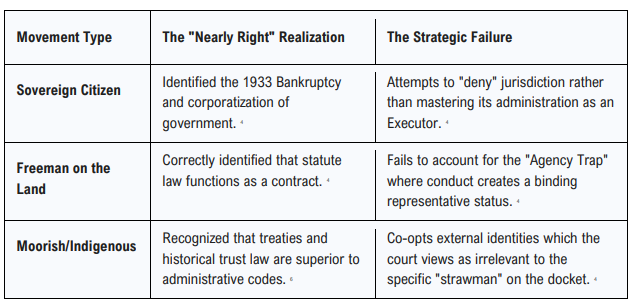
Comparative Analysis: Why They Are "Nearly Right"
Forensic analysis suggests these movements are "nearly right" in their diagnosis of a corporate-legal split, yet they fail to master the "game of Monopoly" due to a fatal category error: they attempt to argue factual reality (biological truth) in a forum designed solely to adjudicate commercial agency.
The Jurisdictional Divide: Law vs. Legal
A fundamental tenet of contemporary ontological resistance is the distinction between "Law" and "Legal," which practitioners define as two entirely separate and often adversarial systems.
The Law: Honour and Inalienable Rights
Under this paradigm, "Law" is identified as the ancient system of honour cantered on the principle of "First Do No Harm." 4 It recognizes inalienable rights such as life and freedom of travel, and holds that every man and woman is personally liable for their actions and omissions.
The 'Legal' System: Corporations and Dead Fictions
In contrast, the "Legal" system is described as a collection of corporate regulations and statutes that treat individuals as non-living entities. 4 Adherents believe this system utilizes "legalese" to redefine people as "corporations," "persons," or "citizens"—terms they interpret as referring to wards of court or slaves.
The Historical Cycle of Trust Enclosure
The "Legal" system is believed to have been constructed through a series of historical "enclosures" to deprive people of property ownership:
• 1302 Unam Sanctam: Pope Boniface VIII claimed ownership of the Earth via the first Crown Trust.
• 1455 Romanus Pontifex: Created the first Testamentary Trust and the initial Cestui Que Vie Trust at birth.
• 1481 Aeterni Regis: Initiated the sale of birth certificates, described as servitude on a "Roman slave ship" (Citizen-ship).
• 1537 Papal Bull Convocation: Claimed all souls for the Ecclesiastical See.
• 1666 Cestui Que Vie Act: Declared all souls "dead" or "lost at sea" to allow the state to manage their property in their absence.
The Maxims and Axioms of Commerce
Movement practitioners rely on internationally accepted "Maxims and Principles of Law" to underpin their commercial filings.
Truth and the Power of the Affidavit
The primary axiom is that "In Commerce, Truth is Sovereign." ] Adherents believe truth is expressed through the instrument of the Affidavit. ]
• An Unrebutted Affidavit Stands as Truth in Commerce: Adherents believe that any point remaining unrebutted in a commercial duel of affidavits becomes an established fact. ]
• He Who Does Not Deny, Accepts: Silence is characterized as a "commercial dishonor" and a confirmation of allegations via "tacit agreement."
Commercial Fairness and Liability
• A Workman is Worthy of His Hire: Used to justify "Fee Schedules" for interactions with state agents. ]
• Right and Fraud Never Abide Together: Foundational belief that if any part of a transaction is fraudulent, the entire subsequent contract is void.
The Common Law Paradigm: Natural Law vs. Statutory Contract
At the centre of most OPCA ideologies is the belief that "Common Law" (or "Natural Law") is the only legitimate legal structure.
Lore vs. Law Adherents often distinguish between "Lore" (the ancient, unwritten rules of the land) and "Law" (the statutory codes of the corporate state). In this worldview, the common law is a baseline of custom that requires only that a living soul does not harm another.
The Rejection of Statutory Jurisdiction
Common law adherents view statutory law as a series of "contract offers" from a corporate government. By refusing to "contract" with the court, they believe they can force the proceedings back into a common law jurisdiction where a jury of peers is required.
The Rules of the Board: HJR 192 and the Bankruptcy of 1933
The modern commercial "Monopoly board" is defined by a state of perpetual bankruptcy that began in 1933 following the suspension of the gold standard.
House Joint Resolution 192 (HJR 192)
Formalized on June 5, 1933, HJR 192 made it unlawful to require payment in gold, declaring that all debts could only be "discharged" using legal tender (Federal Reserve Notes). 4 Adherents argue this proves there is no "real money," only debt instruments used for discharge.
The Nominee Problem: Capturing Credit Energy
Advanced commercial theory posits that entities like banks act as "nominees" on the board. These entities are believed to capture the "credit energy" generated by the individual's signature.
The Redemption Scheme: Recovering the Strawman through the UCC
The UCC Redemption movement provides the technical "paperwork" mechanisms for practitioners to attempt to exit the bankruptcy.
The Birth of the Scheme: Roger Elvick
The movement traces its origins to Roger Elvick in the 1980s, who postulated that since 1933, the federal government has deposited approximately $630,000 in a hidden bank account linked to every birth certificate.
Technical Mechanics of Redemption
1. Filing the UCC-1: Naming the living man as the "Secured Party" and the strawman as the "Debtor."
2. Accepted for Value (A4V): Practitioners use "A4V" stamps on bills to authorize discharge against their Treasury Direct Account (TDA).
3. Instruments of Discharge: Practitioners attempt to pay debts using self-crafted "bills of exchange" or "remittance coupons."
The Perfection of the Record: UCC-1 and UCC-3 Strategy
Advanced practitioners utilize a two-stage filing process: ]
1. UCC-1 Non-Standard Filing: Used to establish a lawful and irrevocable claim over all assets and derivatives tied to the birth certificate.]
2. UCC-3 Amendment and Enforcement: Records "commercial dishonour" if an agency fails to "cure" fraud within a set timeframe.]
The Ontology of the Sovereign Subject and the Reality of Agency
At the heart of modern resistance is the "Agency Trap"—the mechanism used by the state to bind a biological human to the liabilities of an artificial construct.
The Reality of Agency as a Legal Bridge
Agency is the conceptual bridge between the natural and artificial persons. While the biological human is the "Living You" (the player), the birth certificate registration creates the "Artificial You" (the player piece).
Presumption vs. Consent
Under administrative law, agency is often established by "presumed consent." 4 Advanced protocols like the "Envoy Protocol" aim to sever this presumed agency by invoking the principle of Clausula Rebus Sic Stantibus.
Advanced Strands of Resistance: Contractual Denial and the Man Under God Paradigm
The "No Contract" and "No Consent" Fallacy
A dominant trend argues that there is no valid contract between the living human and the state. This "No Contract" defence asserts that since the individual never signed a literal agreement, there is no "meeting of the minds.
The Doctrine of "No Consent, No Jurisdiction"
Adherents believe that the authority of the state is a series of "contract offers" that can be unilaterally declined.
• The Withdrawal of Consent: Often manifested by asking: "Do you have a claim against me?"
• The Linguistic Repudiation: Sovereigns avoid the word "understand," replacing it with "comprehend," as they believe to "understand" is to "stand under" the jurisdiction of the official.
The Man Under God: Spiritual vs. Secular Jurisdiction
This paradigm identifies the legal system as "secular," characterized by the "exclusion of a belief in God from matters of ethics."]
• The Theory of Two Crowns and Two Oaths: Adherents argue the King wears two crowns: one for the jurisdiction under God and one for Roman civil law. ] They believe officials have two oaths of office: one to God to protect the people, and one to the state to rule over citizens.]
De Jure vs. De Facto Governance
Sovereigns believe the original legally rightful ("de jure") republic governed by common law was replaced by an illegitimate, corporate ("de facto") government.
The Constitution Believers and Historical Charter Adherents
The Constitutionalists and the Bill of Rights
In the United States, "Constitution Believers" rely on the Bill of Rights, claiming that "14th Amendment Citizenship" is a second-class status.
The Magna Carta and Lawful Rebellion
In Commonwealth nations, the Magna Carta (specifically Article 61) is used to claim a "Security Clause" for Lawful Rebellion. Adherents often demand a trial by jury of peers for all offenses.
The Petition of Right and the Restoration of the Rule of Law
A foundational tactic involves the service of a formal Petition of Right to the King, which functions as a demand for the Restoration of the Rule of Law. ]
The Hierarchy of Law Affidavit
Adherents structure petitions as notarized affidavits arguing for a specific hierarchy: ]
1. Natural and Divine Law: Superior to any human law. ]
2. Inalienable Rights: Antecedent to any monarchy or government. ]
3. Limitations of Contract: Inalienable rights cannot be waived by contract through "non-disclosure."]
Reliance on Ancient Brehon Law
Esoteric layers of this movement rely on the Senchus Mór and ancient Brehon Law oral traditions.]
The Decree of the House of Ward: Baron David's Affidavit
A ritualized form of resistance centres on the Baron David of the House of Ward protocol. Ward’s "Decree" asserts that the "satanic Roman Empire is no more."
1. Cost Estimation of Fraud: Adherents claim judicial "crimes" have accrued a debt of £4,037.25 Trillion.
2. The 'Warrington Victory': Cites Case WI-05257F as proof that councils cannot provide evidence of the "consent of the governed."
3. Rebuttal of Secret Ballots: Characterizes the secret ballot as an "abomination" that fails to record public consent.
High-Level Declarations: Cosmic Jurisdiction and Corporate Matrices
The Albion Foundation and the D-U-N-S Matrix
The Albion Foundation Protocol involves identifying as a "cosmic consciousness" or "soul". 4 ] It uses D-U N-S numbers to strip away the "pretext of legality" from agencies like "UNITED KINGDOM LTD" (D-U-N-S 237853275). ]
A6.1 Freedom and the Galactic Emissary Status
These protocols assert the individual is a Galactic Emissary with diplomatic immunity under the 1961 Vienna Convention. ] Practitioners often claim copyright ownership of their DNA and issue "Fee Schedules" (e.g., £50,000 engagement fee). ]
Renunciatory Instruments: The Deed Poll and the Kobus Method
The Deed Poll as a Break from the Strawman
Adherents adapt this as a mechanism to "abandon" the corporate "strawman" identity.
The Kobus Method: Mixed-Case Formatting
A specific variant known as the Kobus Method uses Deed Polls to change names into a mixed-case format (e.g., John-Henry: Smith).
Ecclesiastical Deed Polls (Frank O'Collins)
Esoteric layers utilize "Ecclesiastical Deed Polls" to project an appearance of "supereminent authority" over secular tribunals. ]
The Claim of Diplomatic Immunity and the 'State Citizen' Passport
The 'State Citizen Passport' Protocol
Practitioners check "NO" for all U.S. citizenship questions on standard applications to notify the State Department they are "State Citizens" rather than "federal citizens." ]
Safe Conduct and 18 U.S.C. § 1545
Adherents claim this passport places the individual in a "RED FLAG" status. They cite 18 U.S. Code § 1545 (Safe Conduct Violations), threatening officials with prison. ]
The Appointment of the Judge as Trustee trustee
Practitioners often attempt to ritualistically re-appoint the judge from an arbiter of law to a fiduciary ]
The Strategy of Special Appearance
Adherents make a "Special Limited Appearance" on behalf of the "defendant" by holding up a certified birth certificate. ]
The Fiduciary Command
The core argument posits the Judge is the appointed TrustEE and the practitioner is the sole Beneficiary. ] The practitioner asserts the Judge is bound to follow instructions to discharge the matter with prejudice. ]
How to Win in Court: Strategic Execution and Living Standing
The Script for Standing and Role Nullification
Upon being asked their name, practitioners are coached to respond:
"I am the Executor and Beneficiary of the last will and testament of God. What is your standing here? Are you the Trustee? I am administrating here." ]
Establishing "Living Standing"
To counter the presumption that they are a dead legal fiction, practitioners declare:
"Your Honour, I wish to establish that I am a living being. The flesh lives and the blood flows and we are sovereign and nothing stands between myself and the divine." ]
Affidavits over Motions
Practitioners rely exclusively on notarized Affidavits, as they believe an "unrebutted affidavit stands as truth in commerce." ]
The Doctrine of "Color of Law" and Administrative Clerks
Statutes as "Colorable" Law
Practitioners argue all administrative statutes are "color of law," meaning they have the appearance of legal right without the substance. ]
Judges as Ministerial Clerks
Adherents assert that when judges enforce administrative statutes, they are not acting in a judicial capacity but as "extensions of the administrative agency." ]
The Commercialization of Crime: Securitized Court Case Bonds
Adherents believe the courthouse functions as a brokerage house where cases are converted into tradable securities. ]
The Bid, Performance, and Payment Bond Matrix
Adherents believe criminal cases use GSA Form SF24 (Bid Bond), SF25 (Performance Bond), and SF25A (Payment Bond). ]
The Prison Trust and the global Debt Market
Practitioners claim "Default Judgments" are sold to reinsurance companies and managed through Prison Trusts (PZN). ] To settle, they attempt to "redeem the bond" by issuing a conditional acceptance: "I ACCEPT YOUR CHARGE(S) FOR VALUE AND CONSIDERATION".
Courts as Banks: The Financial Ledger of the Judiciary
Adherents claim cases are assigned a CUSIP identifier and floated into investment pooling funds. ]
Financial Remedy via the IRS
Practitioners utilize specific IRS forms to "correct the record": ]
1. IRS Form W-9: Provided to the Clerk to establish the commercial nature of the interaction. ]
2. IRS Form 1099-A & 1099-OID: Filed to "claim the value" of the commercial case. ]
The Right of Subrogation: Commercial and Spiritual Covenants
A specialized strategy within the 2025-2026 movement involves the formal assertion of the Right of Subrogation over court proceedings.
Mandatory Judicial Notice of Subrogation
Practitioners file a Mandatory Judicial Notice and Demand of Prosecutor to Certify in Writing My Right of Subrogation. This document is issued by "private special appearance" in a "non-representative capacity" by the living man. []
The protocol utilizes a spiritual/commercial covenant as a defence:
"Rendering unto Caesar that which is Caesar's in order Caesar be bound by covenant to render unto God that which is God's." [ 4 ]
International Covenants and Case Contract Discharge
Practitioners direct the court to take mandatory notice of the International Covenant on Civil and Political Rights (ICCPR).
The strategic objective is to "subrogate the case contract" based on the belief that the individual's private "bond" is being used to fund the state's proceedings. [ 27 ] By asserting subrogation, the practitioner demands the court eliminate the record and dismiss the charges with extreme prejudice, claiming the right to live as a "free inhabitant" whose accounts are settled.
The Parallel Judiciary: Common Law Courts and Jury Assemblies
As the movement has evolved, adherents have established a parallel judicial infrastructure to supersede the "corporate" legal system. ]
The 12-Step Common Law Trial Process
Movement documents outline a specific procedure for convening these courts and conducting a "Trial by Jury of Peers": ]
1. Compiling Case.
2. Notice of Claim of Right.
3. Forming Court.
4. Oaths of Office.
5. Pre-Trial Conference.
6. Public Summons.
7. Opening Arguments.
8. Main Proceedings.
9. Closing Summaries.
10. Jury Deliberation.
11. Verdict.
12. Enforcement by Sheriff. ]
Quantum Grammar: The Mathematical Correction of Language
One of the most complex yet legally unsuccessful developments in the global movement is "Quantum Grammar," pioneered by the late David Wynn Miller (styled as :David-Wynn: Miller). Officially termed Correct-Sentence-Structure-Communication-Parse-Syntax-Grammar (C-S-S-C-P-S-G), this system posits that the standard English language is a "fiction" designed by the government to "enslave" its citizens through linguistic trickery.
The "Parse-Syntax" Formula
Adherents believe that by applying a mathematical interface to language, they can create "water-tight" contracts that leave no room for subjective interpretation by judges or attorneys. The language is characterized by:
• Static Nouns: The belief that only nouns have absolute legal meaning.
• Mathematical Logic: Sentences typically contain at least 13 words and must begin with a prepositional phrase (e.g., "For the...").
• Exclusion of Adverbs/Adjectives: Users reject these parts of speech as "modifiers" that create "fiction-opinion."
• Gerunds over Verbs: Action verbs are largely removed, with gerunds used to certify facts.
Punctuation as Hieroglyphs A key tactical feature is the use of idiosyncratic punctuation in names. Adherents style themselves using hyphens and colons (e.g., :David-Wynn: Miller), claiming these marks function as "hieroglyphs" that identify the person as a "living fact" existing in the "now-time-dimension." This is intended to distinguish the "living being" from the "all-caps" legal estate found on birth certificates.
Supranational Authority and Postal Courts
Miller also originated a narrative involving the Universal Postal Union (UPU) as a supreme authority. Practitioners may claim status as "Postmasters" and use postage stamps on legal documents, believing this transforms the documents into "correspondence" governed by international postal treaties rather than local statutes. Miller's associates even established a "Federal Postal Court" to release default judgments against banks and government agencies. Despite these elaborate theories, courts routinely reject Quantum Grammar filings as unintelligible "gibberese."
The Court of Record: Sovereignty through the Infallible Roll
Adherents define a Court of Record as possessing a written record of proceedings enrolled on "parchment for a perpetual memorial," whose truth cannot be questioned. 4 ] Practitioners "press the record" using spoken testimony and believe the only way to challenge a decision is through a Writ of Error. ]
The 'Bean-Spilling' of Judge Dale: The Admiralty Trap and the Cesta Que Trust
Retired judge Judge Dale is a critical source of internal knowledge for the movement. ]
The Admiralty "Underwater" Theory
Dale postulates that the Washington Monument (sea-level obelisk) infers America is "under water" and subject to the Laws of Admiralty. ]
Reinvestment of the Cesta Que Trust
Dale asserts birth certificates are converted into securities and Assigned a CUSIP number. ]
Profits move into a hidden Cesta Que Trust, which Dale argues pays for all public services. ]
The Twelve Presumptions of the Bar Guild
Forensic analysis reveals a core belief that the judiciary operates on twelve rebuttable presumptions: ]
1. Public Record. 2. Public Service/Oath. 3. Immunity. 4. Summons/Custody. 5. Court of Guardians/Trustees. 6. Government as Executor/Beneficiary. 7. Executor De Son Tort. 8. Incompetence/Guilt.
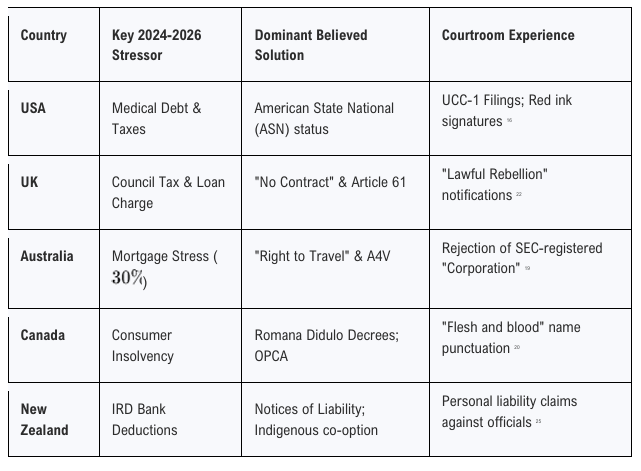
Popular Beliefs and Courtroom Experiences by Jurisdiction (2024-2026)
The Economic Drivers of 2024-2026: The "Monopoly" Metaphor
The surge in these movements is linked to macroeconomic instability. ] As inflation remains "sticky," a growing population feels "mathematically guaranteed" to lose their livelihoods.
Judicial and Institutional Responses
Judiciaries respond by declaring frequent filers "vexatious litigants."] Law enforcement and judicial officials receive specialized training to identify indicators—red ink, thumbprints, and linguistic shifts.
Winning at Monopoly: The Republic of Old Souls and the Master's Path
The Republic of Old Souls (ROS) and Iain Clifford offer a technical framework: ]
1. Envoy Protocol: Rescind presumed agency to transition into the Office of General Executor.
2. Currency Creation Protocol: Recoup "abandoned credit" using 98-Series Trusts.
3. Asset Fortress Protocol: Transfer title of assets into a private treasury.
4. Commerce Protocol: Converts businesses into Self-Supporting Ministries.
Conclusions: The Future of the Sovereign Phenomenon
As of 2026, practitioners seek to move from being a "pawn" to a "banker" (General Executor) who understands that while debt stays "on the board" with the fiction, the living soul is free.
Works cited
1. Legal Insights on Meads v. Meads | PDF | Justice | Crime & Violence - Scribd, accessed on March 1, 2026, https://www.scribd.com/document/695135395/Donald-J-Netolitzky-After the-Hammer-Six-Years-of-Meads-v-Meads
2. View of Organized Pseudolegal Commercial Arguments as Magic ..., accessed on March 1, 2026, https://albertalawreview.com/index.php/ALR/article/view/2485/2470
3. Pseudolaw - Wikipedia, accessed on March 1, 2026, https://en.wikipedia.org/wiki/Pseudolaw
4. MONOPOLY GAME PROBLEMS MY PROTOCOLS WILL SOLVE THEM.pdf
5. Coordinated Global Response Needed for Growing Sovereign Citizens Movement, Report Says - HSToday, accessed on March 1, 2026, https://www.hstoday.us/subject-matter areas/counterterrorism/coordinated-global-response-needed-for-growing-sovereign citizens-movement-report-says/
6. The global sovereign citizen movement | Lowy Institute, accessed on March 1, 2026, https://www.lowyinstitute.org/publications/global-sovereign-citizen-movement
7. Sovereign Citizens - Institute for Strategic Dialogue (ISD), accessed on March 1, 2026, https://www.isdglobal.org/isd-explainer/sovereign-citizens/
8. An Overview of the Common Law Court Movement - Pennsylvania General Assembly, accessed on March 1, 2026, https://www.legis.state.pa.us/WU01/LI/TR/Transcripts/1997_0139_0007_TSTMNY.pdf
9. What Sovereign Citizens Believe - The George Washington University, accessed on March 1, 2026, https://extremism.gwu.edu/sites/g/files/zaxdzs5746/files/downloads/JMB%20Sovereign%20 Citizens.pdf
10. A QUICK GUIDE TO SOVEREIGN CITIZENS - UNC School of Government, accessed on March 1, 2026, https://www.sog.unc.edu/sites/www.sog.unc.edu/files/Sov%20citizens%20quick%20guide% 20Nov%2013.pdf
11. Freeman on the land movement - Wikipedia, accessed on March 1, 2026, https://en.wikipedia.org/wiki/Freeman_on_the_land_movement
12. The Sovereign Citizen Movement and Potential Impacts on Lending Institutions, accessed on March 1, 2026, https://www.poynerspruill.com/thought-leadership/the-sovereign-citizen movement-and-potential-impacts-on-lending-institutions/
13. What do judicial officers need to know about sovereign citizens?, accessed on March 1, 2026, https://www.judcom.nsw.gov.au/publications/benchbks/judicial_officers/sovereign_citizens_ need_to_know.html
14. Sovereign citizen movement - Wikipedia, accessed on March 1, 2026, https://en.wikipedia.org/wiki/Sovereign_citizen_movement
15. Sovereign citizens: ideology, impacts and judicial responses, accessed on March 1, 2026, https://www.judcom.nsw.gov.au/publications/benchbks/judicial_officers/sovereign_citizens. html
16. Sovereign Citizens: A Growing Domestic Threat to Law Enforcement | FBI - LEB, accessed on March 1, 2026, https://leb.fbi.gov/articles/featured-articles/sovereign-citizens-a-growing domestic-threat-to-law-enforcement
17. How Financial Institutions Should Handle “Sovereign Citizens” - Amundsen Davis, accessed on March 1, 2026, https://www.amundsendavislaw.com/banking-brief-financial-services insights/how-financial-institutions-should-handle-sovereign-citizens
18. Sovereign Citizens Sentenced to Prison for Debt Elimination Scheme - Justice.gov, accessed on March 1, 2026, https://www.justice.gov/usao-sc/pr/sovereign-citizens sentenced-prison-debt-elimination-scheme
19. Sovereign citizens: Arguments used in Court and what the law says - YouTube, accessed on March 1, 2026, https://www.youtube.com/shorts/UUndG5cDW4Y
20. A QUICK GUIDE TO SOVEREIGN CITIZENS - UNC School of Government, accessed on March 1, 2026, https://www.sog.unc.edu/sites/default/files/course_materials/05_Crowell%20Sovereign%20c itizens%20briefing%20paper%20Sept%2012.pdf
21. SYMPOSIUM - The Meaning and Legacy of the Magna Carta, accessed on March 1, 2026, http://magnacarta800th.com/wp content/uploads/2011/10/PS_The_Meaning_and_Legacy_of_the_Magna_Carta_Article.pdf
22. house of commons - PARLIAMENTARY DEBATES - UK Parliament, accessed on March 1, 2026, https://hansard.parliament.uk/pdf/commons/2021-05-24
23. Sovereign Citizens and QAnon: The Increasing Overlaps with a Focus on Child Protective Service (CPS) Cases - ResearchGate, accessed on March 1, 2026, https://www.researchgate.net/publication/371069352_Sovereign_Citizens_and_QAnon_The _Increasing_Overlaps_with_a_Focus_on_Child_Protective_Service_CPS_Cases
24. OPCA Litigants: Their Own Worst Enemy. - Velletta Pedersen Christie, accessed on March 1, 2026, https://victorialaw.ca/opca-litigants-worst-enemy/
25. Fitting the Bill - Office of Parliamentary Counsel, accessed on March 1, 2026, https://www.opc.gov.au/sites/default/files/2023-01/fitting_the_bill%20%281%29.pdf
26. 2026 Macro and Private Markets Outlook: Sustained Resilience - ICG, accessed on March 1, 2026, https://www.icgam.com/2026/01/23/2026-macro-and-private-markets-outlook sustained-resilience/
27. RIGINAL - MT Supreme Court Docket Search, accessed on March 1, 2026, https://juddocumentservice.mt.gov/getDocByCTrackId?DocId=269600
28. OPCA Litigants – The Phenomenon of Freemen on the Land - Law Society of Alberta, accessed on March 1, 2026, https://www.lawsociety.ab.ca/resource-centre/key resources/legal-practice/opca-litigants-the-phenomenon-of-freemen-on-the-land/