ANALYSIS OF THE SOVEREIGN PROJECT & THE ADMINISTRATIVE PROCESS FALLACY
23rd January 2026
1. Executive Summary
This paper evaluates the methodology promoted by The Sovereign Project (founded by Pete Stone), a prominent educational platform within the "Common Law" and "Freedom" communities. The project offers a suite of templates and strategies designed to challenge corporate and government authority, primarily utilizing the "Three Letter Process," "Conditional Acceptance," "Name Copyrighting," and "Surety" arguments.
Ecclesia Law categorizes The Sovereign Project’s methodology as a "Combatant Strategy" rather than a "Status Correction Strategy." While the project successfully identifies the fraudulent nature of the system (the Strawman/Legal Fiction), its operational remedies are fundamentally flawed. They attempt to weaponize domestic contract arguments within a statutory bankruptcy jurisdiction, a tactical error that frequently results in users being labeled "vexatious litigants" or "belligerent," accelerating enforcement rather than halting it.
2. The Sovereign Project Model: Core Offerings & Tactics
The Sovereign Project acts as a "self-help" portal for individuals facing debt collectors, court summons, fines, and utility disputes. Based on its public materials and curriculum, its primary tools include:
• The Three Letter Process (3LP): A sequential template system sent to debt collectors (Notice 1, Notice of Estoppel, Notice of Fault). It demands "Proof of Claim," "Verification of Debt," and a "Deed of Assignment." The goal is to create a "tacit agreement" through the collector's silence.
• Conditional Acceptance: A strategy of never refusing a claim outright (which is dishonor) but accepting it conditionally upon proof of facts that the claimant cannot provide (e.g., "I accept your claim upon proof that you lent me money of substance" or "upon proof that a contract exists between us").
• Copyrighting the Strawman: A process of recording a copyright notice for the all-caps legal name and issuing "Fee Schedules" to anyone who uses it without permission.
• Data Subject Access Requests (DSAR): Weaponizing GDPR laws to force companies to reveal what data they hold, often used to stall or frustrate proceedings by burying the opponent in compliance work.
• "Surety" Arguments: Instructing users to ask courts, "Who is the Surety?" or "Are you seeking the Surety?" to distinguish themselves from the liable legal person.
• Notice of Liability: Sending notices to individual CEOs or public officials attempting to hold them personally liable for the actions of their corporation/agency.
Intended Mechanism
The theory relies on the maxim "He who does not rebut the affidavit admits it." Proponents believe that if a debt collector or court fails to answer the "Three Letter Process" point-by-point, they are in "dishonor," and the debt is legally discharged by their silence (tacit agreement).
3. The Ecclesia Law Critique: Why It Is Fundamentally Flawed While the theory of The Sovereign Project aligns with some truths regarding the "Strawman" (Legal Person) and the lack of lawful money, the application is non-operational in modern administrative courts.
A. The "Belligerent" Trap (Status vs. Argument)
The Sovereign Project teaches individuals to argue with the system using its own logic (contract law).
• The Flaw: In the eyes of the court, anyone who argues the law, demands "proof of claim," or challenges the judge is acting as a defendant or trustee of the account. By engaging in the argument, you confirm your standing as the "Person" (the debtor).
• Ecclesia Principle: You cannot fight the system as the system's creation. True remedy requires Status Correction (Envoy Protocol) where one does not argue but rather settles or declines jurisdiction based on diplomatic/ecclesiastical standing, not contract disputes.
B. The "Statutes are Contracts" Fallacy
A core tenet of The Sovereign Project is that "Statutes are contracts, and I do not consent."
• The Flaw: This ignores the Police Power of the state and the Bankruptcy Jurisdiction. The State does not need your individual written consent to enforce statutes upon the "Person" (the birth certificate entity) because that entity is their property and resides in their jurisdiction.
• Ecclesia Principle: The State owns the "Person." If you claim to be the Person (even while arguing you are sovereign), the State can regulate its property. You must separate from the Person entirely (via the Envoy Protocol) to escape the statute, rather than arguing the statute is invalid.
C. The "Copyright Name" Error The project suggests you can copyright your name and charge the court fees for using it.
• The Flaw: You cannot copyright the "Legal Name" (e.g., JOHN DOE) because you did not create it; the Crown/State created it via the Birth Certificate. You are the authorized representative, not the owner of the intellectual property.
• Consequence: Courts routinely ignore "Fee Schedules" and "Copyright Invoices" as frivolous "paper terrorism." Attempting to enforce these bills often leads to criminal charges for simulation of legal process or blackmail.
D. The "Three Letter Process" vs. Recoupment
The "Three Letter Process" relies on the hope that the creditor will give up due to the hassle (the "low hanging fruit" strategy).
• The Flaw:
While this works for low-level "zombie debt" collectors who lack paperwork, it fails against primary creditors (banks/HMRC/IRS). When ignored, these creditors simply move to court. The "Estoppel" created by the letters is rarely recognized by a judge, who sees it as an administrative nuisance, not a binding legal judgment.
• Ecclesia Principle: The remedy is not to deny the debt (which is dishonour), but to discharge it using the proper financial instrument (1099-OID/Clifford Protocol). The Sovereign Project offers "arguments" to avoid paying; Ecclesia Law offers "instruments" to settle the account.
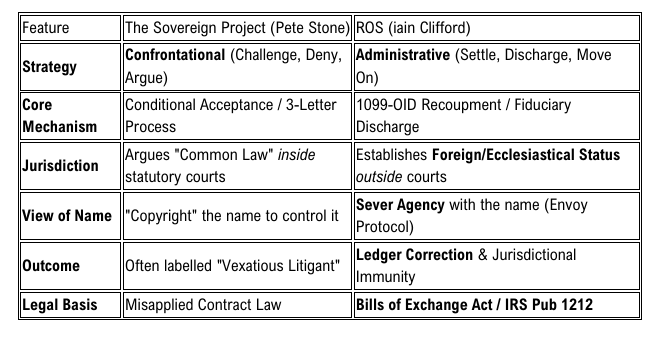
4. Comparison: The Sovereign Project vs. Ecclesia Law
5. Conclusion
The Sovereign Project offers a "Red Pill" introduction to the nature of the legal matrix, but its tools are often "wooden swords." By teaching individuals to engage in commercial warfare using domestic contract arguments, it keeps them trapped in the jurisdiction of the court as belligerents.
Ecclesia Law Verdict: The Sovereign Project is fundamentally flawed because it attempts to solve a status problem with an argument. You cannot argue your way out of a trust relationship where you are presumed to be the Trustee (Debtor). You must correct your status to Beneficiary/Executor (Envoy) and settle the accounts (Clifford Protocol) to achieve freedom.